The Story
How the Yankee Boy Came Back
Told from Frank’s film and the province’s mine records. The quotes are Frank’s own words, from the film.
1900–1936
Est. 1900
Grand Forks was booming in 1900, with a big new smelter in town and claims staked across the hills around it. Three of them, the Yankee Girl, the Yankee Boy and the Bell, made up one property, and that year the Yankee Boy was the only mine in its camp reported to have shipped ore.
“Grand Forks is a small little sleepy town now. But in 1900, suddenly they built the largest smelter in the British Commonwealth…”
The miners chased narrow quartz veins through hard greenstone, carrying gold and silver along with lead, zinc and copper. The work came in bursts. There was a push in 1905, then no recorded work for almost twenty years. Seventeen tons went out in 1925, and shipments followed to the smelter at Trail in 1926, 1930 and 1934.
The big year was 1936: 389 tons of ore, yielding 460 ounces of gold and 382 ounces of silver. By then the Yankee Boy had two main levels, two intermediate levels, a winze, a raise and stopes. Then the work stopped.

1936–2021
The Long Quiet
After 1936 the Yankee Boy went quiet. Geologists came back in the 1980s to take soil samples and run ground surveys across the property, but nobody reopened the workings. The portal caved in. The mine flooded. Much of the timber the miners left behind rotted where it stood.
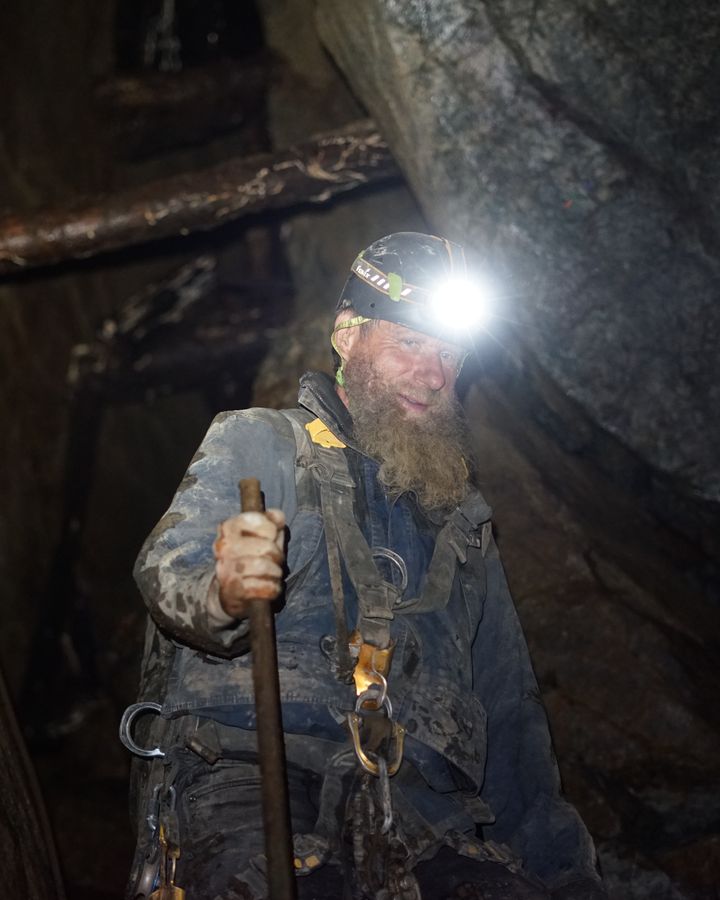
Decades later, working his way in along the main level, Frank came to a plug of rubble.
“This has been plugged off since the ’30s, we think. Nobody alive that we know of has been past here.”
2021
There Was Nothing Here
Frank had spent years exploring abandoned mines all over North America, on ropes and down shafts as deep as 1,500 feet, and filming it all for Exploring Abandoned Mines. What he wanted was a mine of his own.
“Every time I’m in a mine, I always kind of fantasize about… fixing [it] all up and having your own mine.”
So in 2021 he bought one.
“When I purchased this mine in 2021, there was nothing here. The mine was completely collapsed and flooded.”
The ground was steep, and the old road from the 1920s was mostly gone. One of the first things they needed was an excavator; it was badly damaged early on, and they repaired it with parts from a similar machine. A bulldozer with a ripper followed, strong enough to break the rock without blasting. They cut roads into the hillside, milled their own timber from the trees they had to clear, and dug out the caved-in portal, first with a wheelbarrow, then with the excavator and a cable.
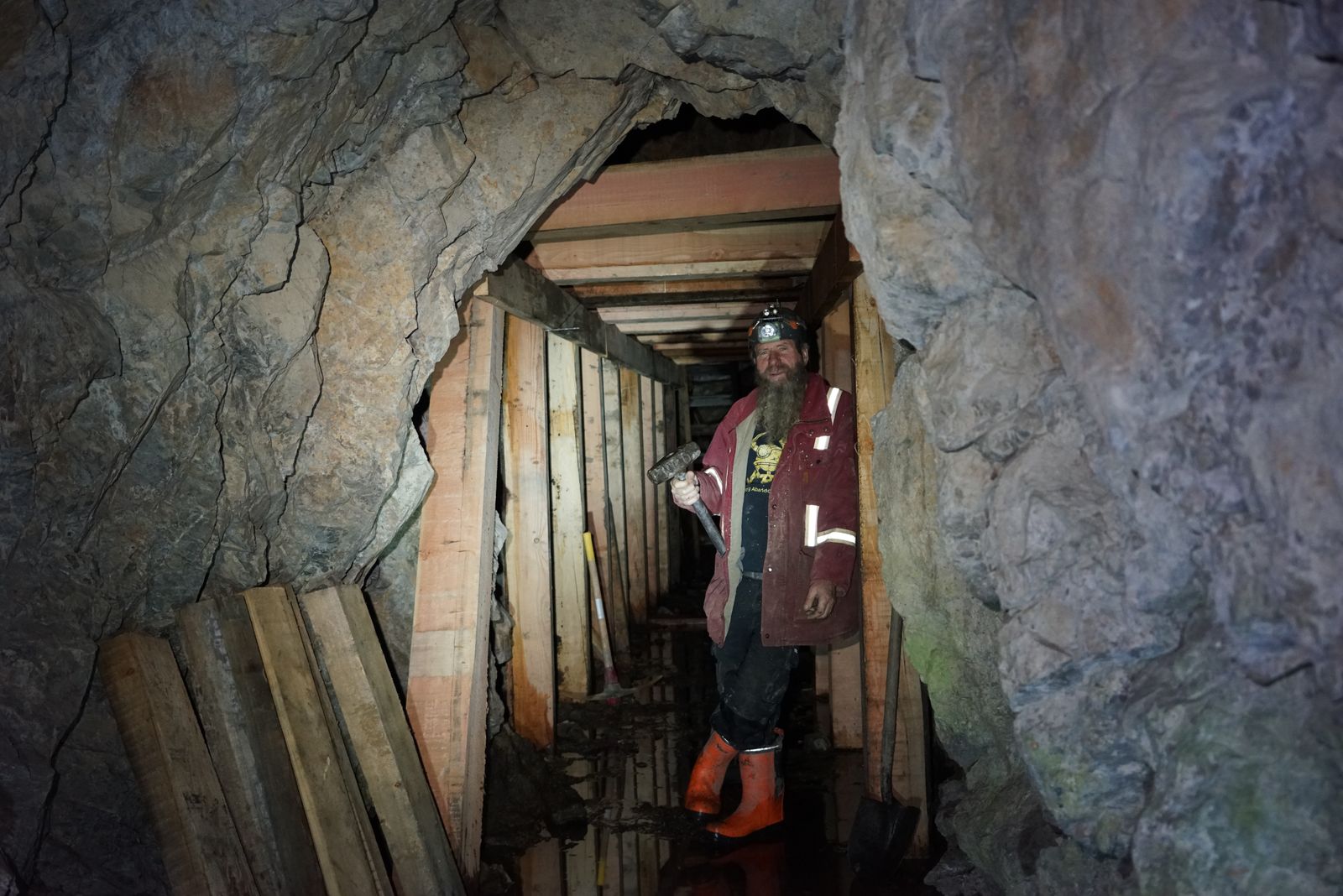
Inside, the first hundred feet was broken, unstable ground. Frank’s rule for it was simple: “It’s got to be totally solid for people to come in here.” So they timbered it, with sets of their own 8-by-8s, 48 inches wide and as close as two feet apart in the worst ground, and put in drains and a concrete dam to keep the new wood dry.

2021–2025
One Load at a Time
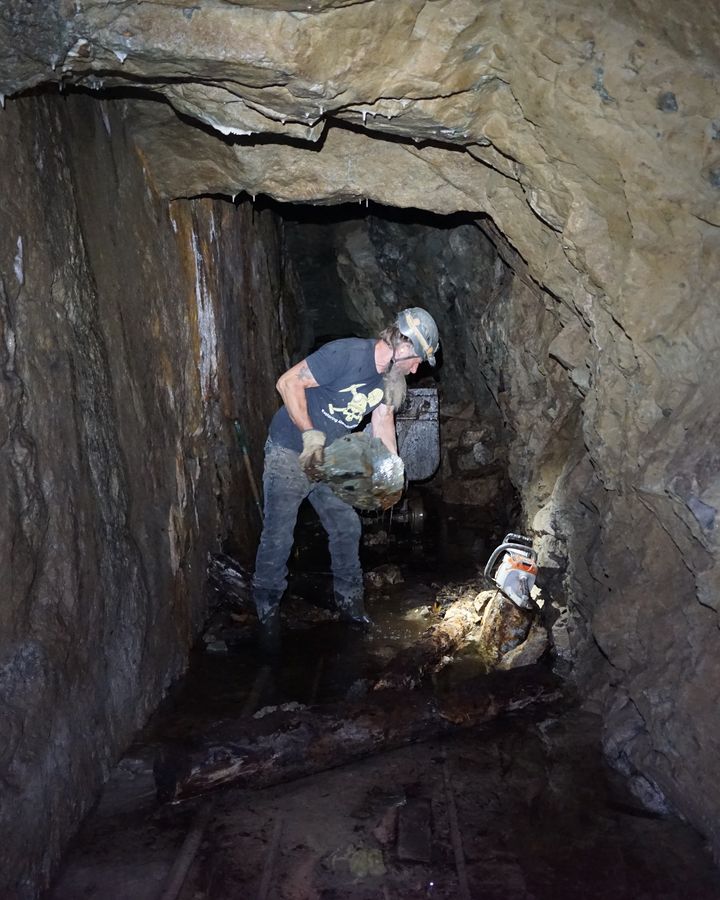
Then came the muck: decades of fallen rock between Frank and the rest of the mine. It went out in the ore car, and they kept count on a board.
The count board
- 17loads in one day
- 334on the verge of breaking through
- 1,000passed after a cold snap iced up the mine
- 2,000exactly, the day after a slide
- 3,500+by the end
“When I first bought this mine, I thought, ‘Oh, wouldn’t it be fun to have your own mine and be able to work in a mine and stuff?’ And, you know, it has been a lot of fun, but a lot more work than I ever would have thought.”
They got smarter as they went. Instead of shovelling every load by hand, they built chutes so the rock would run straight into the car, with a wedge-shaped gate to control the flow. With the chutes working, a car could be loaded in a few minutes. The old-timers had counted too: up on the 2650 level, Frank found that the miners had kept a load count of their own.
By the last winter of work, Frank had a routine. Underground by about 7:30. Three hours of shovelling, with a half cup of coffee every three loads. Out for lunch, then an afternoon of logging or sawing timber.
“We’re doing this for fun. This is what I enjoy doing.”

2022–2024
What the Old-Timers Left
Every blockage they cleared opened more of the mine, and more of what the miners had left behind.
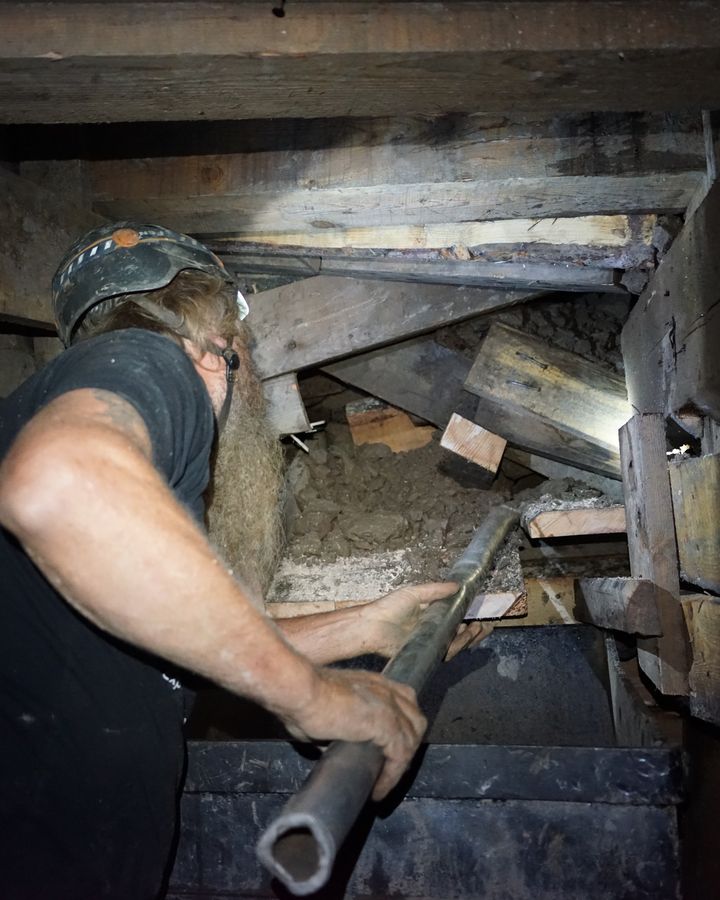
The mine turned out to be bigger than they’d imagined. It had four levels. Four hundred feet in, a three-compartment shaft carried chutes up to the No. 2 and No. 4 levels. A second shaft, 650 feet in, wasn’t on any map. There was a wooden false floor they think covers a winze, and a western small-footed bat that didn’t seem to mind the ore car.
“It was all collapsed and nobody can get in any of these places and, you know, there’s only been a very few people that’s been in here in 100 years.”
2022–2024
Following Their Steps
Frank didn’t only shore the Yankee Boy up. He rebuilt it the way the old-timers would have recognized. Underground, they relaid the track back to a spot they call the 150, using hundred-year-old spikes pulled from other old mines, because spikes like that can’t be bought anymore. They built square sets, the timber framework miners once stood on to work, from a couple of old drawings and what they’d seen underground. And at the 150 they set up a blacksmith’s shop with a forge, a blower, a hand-operated drill patented in 1895, and a call bell once used to call the cage on a shaft.
Beside the main portal they built a museum, mostly from rough lumber milled on the property. It held thousands of pieces from ten years of exploring abandoned mines, laid out to show how the mining was actually done.
“You know, someone did this before all them years ago and here we are following their steps… They got to be happy that we’re doing this… So, it’s really honouring the work and the history of what happened here.”
2023–2024
Two Seasons of Tours
The Yankee Boy opened to the public on May 1, 2023, with the museum and tours underground. Some days twenty or thirty people came through. The next spring, with the houses on the property finished, a second season began.
Up in the old stopes, the work went on. Two new manways of stairs and ladders went in for an advanced tour of the upper levels, named for the two ships of the lost Franklin Expedition: Erebus and Terror.
“The similarity ends there ’cause everyone died on the Franklin Expedition, and we’re hoping to have better luck.”
Every ladder was built so no one would climb more than about fifteen feet at a stretch, the way the old miners did it, and the tours were planned to climb up, not down.
“You can fall down a ladder and hurt yourself, but you can’t really fall up a ladder and hurt yourself.”
Outside, Frank built something very few people have seen working: an aerial tram, its full buckets rolling downhill and pulling the empties back up.
“That’s the only operating tram that I know of in North America, anyways.”

2025–
What’s Next
By the spring of 2025 the work was done. The manways reached the top of the mine, the new levels were ready, and a third season was days away.
“I don’t think we really have any more work to do in here… So, it’s just a matter of just letting people enjoy it now.”
In May 2025, just before the third season was due to open, the mine was closed to everyone, Frank included. It has stayed locked since: timbered, drained, laddered and quiet. Frank tells that part himself at the end of the film.
He hasn’t stopped.
“I’m going to continue… researching mines and documenting mines and providing information to people that [are] interested in history.”
“It remains to be seen what’s next for the Yankee Boy mine.”
Frank, the last line of the film