
- 1913–1947The years it shipped ore, on and off
- 122,555Tonnes of ore mined
- 55,525Ounces of gold
- 1.39 millionOunces of silver
- 64Men at its busiest, in 1929
The claims
Union · Union Fraction · Paper Dollar · Idaho
Position
Pinned at Franklin Camp
The exact position, taken on site, is for readers on the list. Sign in, or join, right here:
Sent to .
Open the message on this device and tap its link: it brings you back to this page, on the list and signed in.
Nothing within a minute? Look in Promotions or Junk. ·
Phoenix Camp
Deadwood Camp
Hardy Mountain Camp
Franklin Camp
Anyox Camp
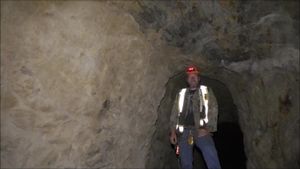
On the pale rock walls inside the Union, men who worked it wrote the years: 1933, 1937, ’41, 1942, 1946.
In two films of 2017, Frank goes down on a rope and reads them aloud.
This is the story of the men who wrote them, and of the men who came before.
The Union’s miners named its workings from the top down: the glory hole, where the rich ore came to the surface, then the tunnels, No. 1 to No. 4. Each level of this record borrows one of those names. Names only: no plan of the workings is shown.
1906
The Outcrop · The galena on top
Four Quarters
On a Tuesday in August 1906, Mike McDonnell and Pat Maginnis struck galena on the Union. By September a cut thirty feet long showed “solid galena from end to end,” the Sun reported.
It was the boom year in Franklin camp. The camp is named for Franklin MacFarlane, “for many years a trapper on this stream”, whose finds in the 1890s, and those of some friends, drew the prospectors in; by 1900 “a little colony of them were busy in this camp.” Now two townsites were surveyed, Franklin City and Gloucester City, and the lots went on sale. By June one hotel was “now doing business”, and the camp was “boomed extensively by mine promoters who freely made use of the newspapers.”
McDonnell had recorded the claim that spring and called it the Union. It was not new ground: John C. Henderson had recorded it in 1905 as the Jackpot. Over the summer McDonnell sold a quarter of it to each of three men: Henderson, Lewis Johnson and Pat Maginnis.
Then came years of assessment work and little else. By 1910 most of the camp’s claims “had been crown granted and allowed to lie dormant.”
Mike McDonnell was very probably the Mike McDonald who died at the Sisters’ Hospital in Greenwood in February 1911, after an illness of several months. When his partners applied for the Union’s certificate of improvements in August 1912, his quarter stood in the name of his estate. He never saw what his claim held.
The Grand Forks Sun · 8 June 1906
“Union, Franklin camp, relocation of Jackpot, Mike McDonnall.”
The four claims of the Union group
- Union
- Union Fraction
- Paper Dollar
- Idaho
The Union Crown-granted on 28 March 1914 to J. C. Henderson, Lewis Johnson, Patrick Maginnis and Donald McCallum, official administrator of McDonnell’s estate; the Idaho and the Paper Dollar Fraction in 1916 (Annual Reports, 1914 and 1916).
1913
The Glory Hole · The rich ore at grass
Five Cars From the Glory Hole
For six years the partners had done their assessment work on the Union’s galena and paid no attention to a band of blue silica. In 1912 a sample of it was assayed, and it gave “astonishingly high values in gold and silver.”
That same year the Gold Commissioner at Grand Forks wrote that in the camps outside those of the Granby and British Columbia Copper companies, work “has not been of more import than to keep the claims that have not been Crown-granted alive.”
In the summer of 1913 the partners cut into the rich ore from the surface, in an open cut the miners called the glory hole. The ore was sacked and “hauled down the hill on a go-devil”, and from there Peter Hansen and Peter Peterson hauled it by wagon to the railway. Below the cut, Patrick Byrnes drove a tunnel.
The first car reached the Granby smelter at Grand Forks on Wednesday, 27 August. “The Union is the first property in either Franklin or Gloucester camps to undertake the shipment of ore on a commercial basis,” the Sun wrote. Two weeks later it reported that “Pat Maginnis has returned from Goose Bay, and is now located at the Union mine in Gloucester camp.”
Five cars went out that year, and a Grand Forks paper said the shipment “consisted of the entire diggings of the glory hole, no selection of ore having been made.” Men came to stake claims around it. “Glowing reports were prevalent about the Union mine in Franklin camp,” a Bureau of Mines engineer wrote that autumn.
In October the province’s assistant mineralogist came up to see it, in heavy snow. That winter the partners put up new mine buildings, “with the intention of vigorously working the property during the ensuing year.”
The Phoenix Pioneer · 8 November 1913
“It is the intention of Louis Johnson, the principal owner, to ship about a carload a week.”
1914
No. 1 · The locators’ years
Paying From the Grass-Roots
By 1914 the Union was the camp’s mine, and two prospectors with no capital were running it. Lewis Johnson managed it and let the haul contracts, and the ore went out at two carloads a week, with seventy horses and more on the haul.
A chute ran down from the glory hole to new ore bunkers, an assay office went up at the mine, and in June W. J. Eaton came from the Granby assay office as foreman. One of the haul contracts went to a Frank McPharlane. Whether he was the trapper the camp was named for, the record does not say.
That spring John Henderson sold Johnson the Union Fraction; by the end of the year Henderson was out of the partnership. “The mine as worked by the locators has been a paying proposition from the grass-roots,” the Gold Commissioner wrote, and their success “has given quite an impetus to prospect-work in the two camps.”
When war came, the Granby smelter closed for the last four months of the year, and the Union’s ore went to Trail. It kept shipping through the war: twelve men and two cars a week early in 1915, when it was the camp’s “only producer”. A motor truck tried the haul in 1916, and its second load went over the dump; no one was hurt. The horses came back, thirty-two of them on the haul in January 1917, and that July a Republic truck made three trips a day.
In June 1917 nearly a hundred men were mining in Franklin camp, “the largest number for more than a decade.” In December the Union closed for the winter: the ore could not be hauled to the railhead in the winter months.
A. G. Larson, for the Bureau of Mines · 1914
“This property is owned by two prospectors, Louis Johnson and Patrick Maginnis, and the estate of a third, deceased. With no capital, these two men have opened up their property and are now shipping from 30 to 40 tons of ore a day to the Granby smelter.”
1920
No. 2 · Waiting for a mill
The Long Wait
In September 1918 Lewis Johnson worked as guide and helper to a visitor from the Munition Resources Commission, who had come to sample the Union for platinum. Johnson had put him up in August, and now, with a helper hard to find, he did the work himself. He “proved to be a reliable and agreeable assistant,” the visitor wrote. The platinum came to a trace.
What the Union needed was a mill. “The present owners are endeavouring to obtain enough capital to install a mill and treat the ore at the mine,” the 1917 report says. Buyers came to look: “Eastern American capital”, a local engineer, Vancouver men acting for Toronto money. None came to terms with the owners, and in November 1918 Bruce White of Nelson, “who had a deal pending for the Union mine”, died of influenza.
In 1919 three of the owners were working it themselves, Johnson, Maginnis and John McDonald, and in December the Sun reported “a splendid strike of shipping ore”. In 1920 they formed the Union Mining and Milling Company to raise money for development and a mill, and “the tightness of the money market” stopped it. By 1922 the partners could not agree on selling stock or leasing the mine, and in 1925 it lay idle.
In 1926 Johnson and Maginnis, the two locators still at it, were driving No. 2 tunnel on. They had held the Union for twenty years.
Annual Report of the Minister of Mines · 1922
“The Union is one of the best partially developed low-grade mines in the district, and if carefully managed may make a steady producer.”
1927
No. 3 · The company comes
Hecla Comes
On Saturday 29 October 1927, twenty-one years after Johnson and Maginnis bought their quarters, the Hecla Mining Company of Wallace, Idaho, took a bond on the Union from its owners, “Louis Johnson, Pat Maginnis, and the McDonnell Estate”. Every payment was to come “out of ore or metal shipped”.
Paul H. Schulz took charge. In November a compressor went up and “a gang of men” repaired the old camp buildings, and in early December the first blast went off under the new management. The next summer a six-horse team hauled in one piece of machinery that weighed six tons.
By the end of 1928 Hecla had put up a dining-room and kitchen “with a seating capacity for fifty men”, a blacksmith shop with two forges and an engine room with a dry, and a generator lit the whole camp. An average of twenty-six men worked there that year.
In January 1929 Lewis Johnson fell while working outside the mine and broke his wrist and his nose, and the superintendent took him out by sleigh. “Lewis Johnson, Owner of Union Mine,” the Nelson Daily News called him.
Hecla drove a new haulage tunnel, No. 4, below the old ones, and in 1929 built a modern camp: a two-storey bunkhouse with “two men in a room … hot and cold water, electric lighting”, two four-room houses, an assay office, a four-car garage, a diesel plant for power, and a mill. That year sixty-four men worked at the Union, and the inspector called it “the largest operating property in the Grand Forks Division.” Every round blasted in the stopes and levels, the 1929 report understood, would be sampled and assayed before it went to the mill.
The mill started on 28 December 1929. Pat Maginnis, who had struck the galena with McDonnell in 1906, still went up to the mine.
1930
No. 4 · The haulage level
A Mule and Six Dump-Cars
In 1930 all of the Union’s ore came down through the mine to No. 4 level, where “a mule and six dump-cars” trammed it out to the 300-ton mill-bin. About sixty men worked there, and the mine ran all year, “except for time lost occasioned by plant breakages and a few days during the Christmas holidays.”
The ore was harder than expected, and early in the year about twenty men were laid off until a new ball mill came. Two assayers worked full time, taking “in the neighbourhood of 100 samples a day” from the headings and stopes. The concentrates went out by truck and rail to the smelter at Trail.
The Union had changed what it was. “The Union, in Grand Forks Division, started two years ago as a silver-mine, may to-day be rated as a gold-mine,” the province’s lode-gold bulletin said, and in 1930 nearly all of British Columbia’s gold-mine output came from five mines: the Premier, the Pioneer, the Nickel Plate, the Union and the Reno.
On Friday 3 October Joseph Sanigala was at the foot of a timber chute in No. 4 tunnel, loading steel, when rock came down the chute and struck him on the head. He died on the way to hospital.
The mine closed the next day for the investigation, and the coroner found his death accidental. He left a wife and three stepsons. He was buried in Evergreen Cemetery at Grand Forks, after a requiem mass at Sacred Heart. The report names him Joseph Shangalo, driver. He is the only man the record shows killed at the Union.
In memory · 3 October 1930
“The fatal accident which occurred to Joseph Shangalo, driver, Union mine, on October 3rd was due to his being struck on the head by some object which had apparently come down a timber chute where he was loading steel.”
1931
Between No. 1 and No. 2 · The richest ore
The Richest Car
In October 1931 one car of ore, 54 tons, went raw from the Union to the Bunker Hill smelter in Idaho. It carried about forty ounces of gold to the ton.
It came from the best ore the Union ever found, in richer shoots between No. 1 and No. 2 levels. The new ore “has prolonged the life of the Union mine operations, which were destined to end shortly after the New Year,” the report for 1931 says. Byron Wilson was in charge by then; Paul Schulz, superintendent since the start, had left for California at the end of 1930, “chiefly on account of health”.
1931 was the Union’s biggest year. By the province’s production figures only the Premier and the Pioneer turned out more gold in British Columbia, and only the Sullivan and the Premier more silver. In 1932 it made more gold than ever, fourth in the province.
That August John McDonald died in the Grand Forks hospital, aged 58. He had worked the mine with Johnson and Maginnis in 1919 and 1920, and for ten or fifteen years he had made his home in Franklin camp.
Then the rich ore was gone. Nearly all of 1932’s ore came from those same shoots. The mill closed at the end of October, and early in 1933 the mine stopped, “due to a shortage of developed ore.” Diamond drills went looking past the Maple Leaf fault and found no more.
Where Lewis Johnson and Pat Maginnis ended their days, this record has not yet found.
The Financial Post · 21 November 1931
“One of the most valuable shipments of gold ore made in British Columbia.”
1942
Below No. 4 · The lessees
The Lessees
“A small crew is working the leased Union ore body,” the Nelson Daily News reported in January 1940. It was W. E. McArthur’s crew, from Greenwood. He worked the mine under lease and bond from 1939, with a crew of six in 1940 and two to four men in 1941.
Before him, Hecla put up a small cyanide plant late in 1933 to re-treat the old mill tailings, “approximately 100,000 tons” of them, and for three summers it worked the tailings and the ore left in the stopes. In 1937 A. J. Fee & Co. of Grand Forks leased the mine.
The war was hard on the province’s gold mines: the 1942 report lists labour shortages, rising costs, restrictions on equipment and competition from the war industries. McArthur gave up the Union in June 1942. The last ore on record went out in 1947: six tons, shipped by C. E. and J. E. Small of Grand Forks.
It was not left alone for good. A cyanide plant on the old tailings in 1971 “proved uneconomic and was closed after operating for several months.” In the 1980s Pearl Resources reopened No. 4 level, and Sumac Ventures reopened No. 3 and No. 4 and, from 1987, ran a cyanide heap leach on the old dumps and tailings, until a leak of cyanide into the ground water near the leach operations brought a pollution abatement order in April 1989. The operation closed, and the province took over the clean-up.
Annual Report of the Minister of Mines · 1942
“An average crew of four men was employed until June 1st, 1942, when the property was closed and the option was dropped.”
Now
The Glory Hole · Today
Seven Films Down
Frank’s first Union film was published in June 2016, and six more followed, the last in August 2019. Across them he went through the old stopes and ore chutes from the top of the mine down, a level at a time.
From the films
From Frank’s films of 2017 and 2019.
Frank · From film No. 151, 2019 The wall · From film No. 66, 2017, at 12:10 Frank · From film No. 160, 2019 Frank · From film No. 146, 2019
Up top, little is left. The mill’s footings are there, and the camp has been cleared and seeded over. Who cleared it, and when, this record has not yet found.
In 2016 Frank went back in to check a bat monitor left there for a survey. It logged 41 calls, which he says were identified as Townsend’s big-eared bats. The old workings are their home now.

On the walls Frank found the dates the miners wrote: 1933, 1937, ’41, 1942, 1946. Every one is a year the record puts men at the Union: Hecla’s last year of exploration, A. J. Fee’s lease, W. E. McArthur’s lease and the year it ended, and the Smalls’ last shipment, which the province’s metal table dates to 1946 and its report to 1947.
He read each one aloud.
Film No. 62 · 28 minutes
More Adventures in the Union Mine
Published 3 August 2017. Frank goes back into the Union alone, works down through the old workings and reads the dates the miners left on the walls.
All Seven Union Films
Frank and the record
What He Found, and What the Record Says
Set beside the province’s old reports, what Frank found and said in the Union mostly lands where the record says it should. Where a year has slipped, the record has the right one.
Matches
From the Top Down
“I think this was the very top of the mine when it was first discovered … they probably found gold at the top and then put an adit in right here … mined starting from the top kind of working down.”
The first ore came out of the open cut, the glory hole, in 1913, and the tunnels came after, numbered from the top: No. 1 was later described as “near the top of the old glory-hole.”
Frank, in film No. 151 (2019) · Annual Reports, 1913 and 1930
Matches
Four Levels
“According to the documentation I have there’s supposed to be four levels to this mine.”
The reports number four tunnels, No. 1 at the top down to No. 4, Hecla’s haulage level, and the province’s record gives four levels.
Frank, in film No. 6 (2016) · Annual Report, 1928 · MINFILE 082ENE003
A few years off
The Biggest in Grand Forks
“This is a pretty big mine … 1938 they were … the biggest producer in the Grand Forks area.”
1938 was a lessees’ year, 40 tonnes. In 1929 the inspector called the Union “the largest operating property in the Grand Forks Division”, and 1930 to 1932 were its big years.
Frank, in film No. 6 (2016) · Annual Report, 1929 · MINFILE production table
Matches
The Richest Year
“1932 I believe was the richest year they had here … the ore ran out in 1932 and then 1933 [they were] drilling all over the place.”
1932 was the Union’s biggest gold year, 19,218 ounces. The mill closed at the end of October, and in 1933 the diamond drills went looking and found no more ore. (In later films Frank put the big year in 1934, when only the old tailings were being treated.)
Frank, in film No. 62 (2017) · Annual Reports, 1932 and 1933
Matches
The End of the Deposit
“That’s basically the end of the deposit … there’s some couple exploration tunnels … they just dead-end.”
The mine stopped early in 1933 for want of ore, and that year’s drilling past the Maple Leaf fault found no more. Faults cut the vein off; companies were still looking for the missing piece, the “West Union”, in 2001–04.
Frank, in film No. 151 (2019) · Annual Report, 1933 · MINFILE 082ENE003 · exploration reports, 2001–04
Matches
The Dates on the Walls
“1933, which is the big year when they’ve done the big exploration.”
1933 was the year Hecla stopped mining and drilled for more ore. The other dates he read fit too: 1937 (A. J. Fee’s lease), ’41 and 1942 (W. E. McArthur’s lease, given up in June 1942) and 1946 (the Smalls’ last shipment, dated 1946 in the province’s metal table and 1947 in its report).
Frank, in films No. 62 and No. 66 (2017) · Annual Reports, 1933–1942 · BC METAL
Matches
The Last Go-Around
“This looks like the last go around with the Union mine … it’s newer … ’70s maybe ’80s I’m not sure … pretty modern construction.”
The last work underground was in the 1980s: Pearl Resources reopened No. 4 level in 1984, and Sumac Ventures reopened No. 3 and No. 4 in 1986–87.
Frank, in film No. 6 (2016) · MINFILE 082ENE003 · assessment reports, 1984–88
Matches
Straight Down
“The deposit is a little unique, because it’s pretty much straight vertical.”
The province’s record: the vein “dips vertically”.
Frank, in film No. 151 (2019) · MINFILE 082ENE003
Still to find
Reclaimed
“It’s kind of a shame that everything’s been reclaimed here … they went through and … just demolished everything and [reseeded] it.”
Hecla’s mill and camp of 1929 are on the record; who took them down and seeded the ground, and when, is not yet found. A survey in 2015 found concrete foundations where the mill likely stood.
Frank, in film No. 6 (2016) · assessment report 35780 (2015)
Can you help?
Who Took the Mill Down?
Hecla’s mill ran from 28 December 1929 to the end of October 1932. If you know who took it and the camp down, or you have a photograph of the mill, the camp or the men who worked there, it would help this record.
Write to Frank →
The ledger
Every Year the Province Counted
Tonnes of ore mined each year from 1913 to 1947, from the province’s own production table. In 1934–36 only the old tailings were treated, and in 1987–89 the heap leach re-treated dumps and tailings: their gold and silver are in the totals, but no new ore was mined. Point at any year to read it.Touch the chart and slide along it to read any year.
193151,465 tonnes mined, the biggest year, and the richest car
- Tonnes mined
- The biggest year
- 122,555Tonnes of ore
- 55,525Ounces of gold
- 1.39MOunces of silver
- 19Years ore was mined
Every year’s figure, as a table
| Year | Tonnes of ore | Ounces of gold | Ounces of silver |
|---|---|---|---|
| 1913 | 122 | 107 | 10,537 |
| 1914 | 1,461 | 1,437 | 48,330 |
| 1915 | 469 | 421 | 17,157 |
| 1916 | 237 | 104 | 9,693 |
| 1917 | 681 | 339 | 21,202 |
| 1918 | 139 | 61 | 6,111 |
| 1919 | 73 | 23 | 2,586 |
| 1920 | 24 | 11 | 919 |
| 1930 | 33,462 | 9,440 | 363,193 |
| 1931 | 51,465 | 16,552 | 580,672 |
| 1932 | 24,020 | 19,218 | 151,534 |
| 1933 | 2,861 | 3,112 | 2,889 |
| 1934 | – | 424 | 11,752 |
| 1935 | – | 1,164 | 43,791 |
| 1936 | – | 601 | 17,904 |
| 1937 | 24 | 107 | 249 |
| 1938 | 40 | 17 | 396 |
| 1939 | 60 | 13 | 371 |
| 1940 | 3,759 | 1,082 | 38,828 |
| 1941 | 2,250 | 589 | 21,612 |
| 1942 | 1,403 | 275 | 29,911 |
| 1947 | 5 | 1 | 43 |
| 1987–89 | – | 428 | 12,635 |
MINFILE 082ENE003, production table. The reports count short tons; the table is in tonnes, as MINFILE converts them. BC METAL’s figures differ a little in 1933, 1936 and 1942. Each year is rounded to the ounce.
The names
The Men on the Record
One man is recorded as killed at the Union: Joseph Sanigala, in No. 4 tunnel, on 3 October 1930. Every year’s list of fatal accidents in the province’s reports from 1906 to 1947 has been read for this record, and every issue of the Grand Forks Sun from 1906 to 1932; his is the only death. The lists for 1936 and 1937 are missing from the reports online, so those two years are still to be checked.
These are the men the record remembers: the ones who staked, owned, managed, leased and worked it. The list is not complete. The owners’ crews and Hecla’s sixty men are counted in the reports but mostly not named.
In memory · 3 October 1930
“Falling Rock Kills Man at Union Mine”
Franklin MacFarlane
1890s
The trapper the camp is named for; staked the Banner, one of its first claims.
John C. Henderson
1905–1914
Recorded the ground as the Jackpot in 1905, took a quarter of the Union in 1906 and stood on its Crown grant in 1914; out of the group by the end of that year.
Mike McDonnell
1906–1911
Located the Union in 1906 and sold a quarter each to his three partners. Dead by 1912; his quarter was held for his estate into Hecla’s years.
Lewis Johnson
1906–1929
Bought a quarter in 1906 and managed the mine for the owners from 1913: the haul contracts, the options, his own sketches of the workings. The principal owner by 1913, with a little over half by 1918.
Patrick Maginnis
1906–1931
Bought a quarter in August 1906 and struck the galena with McDonnell that week; worked the mine with Johnson until Hecla came, and still went up to it in 1929–31.
Donald McCallum
1914–1916
Official administrator at Grand Forks; held McDonnell’s quarter for his estate and stood on the Crown grants of 1914 and 1916. He never ran the mine.
W. J. Eaton
1914
Foreman, then superintendent, for the owners from June 1914; formerly of the Granby assay office.
Forbes M. Kerby
1912–1915
The Grand Forks land surveyor; the owners’ agent for the Crown grants.
John (Jack) McDonald
1915–1932
Of Phoenix; a part owner from 1915 and one of the three owners working the mine in 1919–20. He made his home in Franklin camp; how he came by his share is not stated.
James F. McCarthy
1927–1940
President and general manager of the Hecla Mining Company; the claims were registered in his name from 1930, and his estate held them by 1940.
Paul H. Schulz
1927–1930
Hecla’s superintendent, who built the mill and the camp; the Paul Schulz Stope is named for him. Left for California late in 1930.
W. L. Zeigler
1929
Superintendent of Hecla’s own mill in Idaho; designed the Union’s.
Joseph Sanigala
1930 · In Memory →
Killed in No. 4 tunnel on 3 October 1930, loading steel at the foot of a timber chute. The report calls him Joseph Shangalo, driver.
Byron Wilson
From 1930
Hecla’s superintendent from late 1930.
A. J. Fee
1937
Of Grand Forks; his company leased the Union in 1937.
W. E. McArthur
1939–1942
Of Greenwood; worked the Union under lease and bond until June 1942, when the option was dropped.
C. E. and J. E. Small
1947
Of Grand Forks; shipped the last six tons.
Names and years from the Annual Reports of the Minister of Mines, 1913 to 1947; the Grand Forks Sun, Greenwood Ledge, Phoenix Pioneer, Boundary Creek Times and Nelson Daily News, 1905 to 1932; the BC Gazette, 1913–15; and the province’s BC METAL table.

The Union Record
Take the Whole Record With You
One PDF, made to be printed and kept. It carries this page’s story, the ledger and the province’s own entries for the Union, from 1911 to 1947.
- Part 1The story of the Union, 1906 to today, with the photographs of 1911, 1914, 1928 and 1930
- Part 2The ledger, 1913 to 1947, year by year, and the men on the record
- Part 3The Annual Reports’ entries, 1911 to 1947, and the MINFILE record
The Union Record · PDFComing soon
Record card
- MINFILE No.
- 082ENE003
- Status
- Past producer
- Names on the record
- Union · Union Fraction · Paper Dollar · Idaho
- Production
- 1913–1947: ore mined in nineteen of those years; tailings and dumps re-treated in 1934–36 and 1987–89
- Commodities
- Gold, silver; lead, zinc and copper recorded
- Camp and division
- Franklin Camp · Boundary Country · Greenwood Mining Division
The provincial record, last edited 9 April 2015, as MINFILE 082ENE003. Where it differs from the old record: it has L. Johnson and associates locating the Union, where the Mining Recorder’s list of June 1906 names Mike McDonnell; and it puts W. E. McArthur’s lease in 1937, where the report for that year names A. J. Fee & Co.
Questions
Five Questions People Ask About the Union Mine
When Was the Union Mine Worked?
From 1913, when its owners shipped the first car of ore from the glory hole, to June 1942, when the last lessee gave it up; six more tons went out in 1947. The claim was staked in 1906, and its big years were 1930 to 1932, under the Hecla Mining Company of Wallace, Idaho.
How Much Gold Came Out of the Union?
About 55,500 ounces of gold and 1.39 million ounces of silver, by the province’s record of production: 122,555 tonnes of ore were mined, and the old tailings and dumps were re-treated twice. Its biggest gold year was 1932, with 19,218 ounces; in 1931 only two mines in British Columbia produced more gold.
Who Owned the Union Mine?
Four men held it from 1906, a quarter each: Mike McDonnell, who located it, John C. Henderson, Lewis Johnson and Pat Maginnis. Johnson and Maginnis worked it themselves from 1913, with McDonnell’s quarter held for his estate. In 1927 the Hecla Mining Company took a bond on it, and the claims were registered to its president, James F. McCarthy.
Why Did the Union Close?
It ran out of ore. Hecla’s mill closed at the end of October 1932, and mining stopped early in 1933 “due to a shortage of developed ore.” The old tailings were re-treated until 1936, and lessees worked what was left until 1942.
Which Union Mine Is This?
The Union of Franklin camp, in the Boundary Country of British Columbia: MINFILE 082ENE003. It is not the Union Colliery at Cumberland on Vancouver Island, nor the Unions at Rossland and Hedley.
Sources and records
The Annual Reports of the Minister of Mines, British Columbia, 1905 to 1955 · BC Geological Survey, MINFILE 082ENE003 and its production table, and the BC METAL table of historical metal production, mine MM00145 · A. G. Larson’s report of 1914, with its four photographs, and Lewis Johnson’s sketches of 1914 (BC Property File) · BC Bureau of Mines Bulletin 3 (1914) and Department of Mines Bulletin 1 (1932) · R. W. Brock, The Geology and Ore Deposits of Franklin Camp (Canadian Mining Institute, 1907) · C. W. Drysdale, Geological Survey of Canada Memoir 56 (1915), for the photograph of 1911; the Annual Reports’ plates of 1928 and 1930 from UBC Library’s scans of the Sessional Papers · W. Thomlinson, Munition Resources Commission, Final Report (1920) · The Grand Forks Sun, 1905–32; the Greenwood Ledge, 1906–29; the Phoenix Pioneer, 1900–16; the Boundary Creek Times, 1896–1911; and the Nelson Daily News (UBC Library Open Collections) · The BC Gazette, 1913–15; the Engineering and Mining Journal, 1927–31; the Canadian Mining Journal, 1914–17; the Financial Post, 1924–41 (Internet Archive) · Exploration and assessment reports, 1971–2015 · Frank’s seven Union films, 2016–19, and film No. 35 (2016).
Where Frank’s films and the record disagree (the year of the biggest production, the year the mine closed), the page follows the record. Updated 5 November 2026.
From the Journal
Stories About Union
Shorter pieces written since the record, each dated and sourced. The record itself changes only when a story establishes something that belongs in it.
-
The People Behind the MineOut With Frank
The Names on the Walls of the Union Mine
The record isn’t finished
Did someone in your family work at the Union, or in Franklin camp? A photograph, a letter or a name would help this record.
Letters from a Retired Madman
One Photograph. One Story. Once a Month.
Frank picks one photograph out of the archive and tells the story of the day it was taken.
Unsubscribe anytime.
