Out With FrankThe People Behind the Mine
Then and NowHistory & Discoveries
The Journal →Anyox at Full Blast, 1917
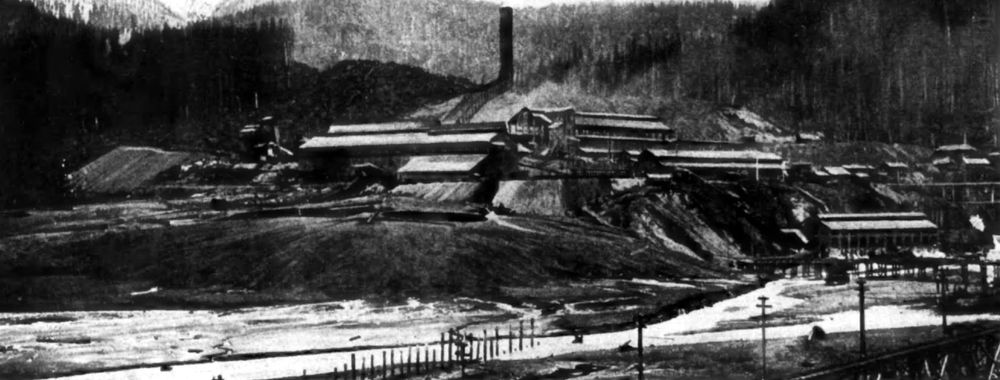
In October 1917 a mining journal printed fifteen photographs of Anyox at its height: the mine, the smelter, the powerhouse and the town. A century later Frank Schlichting’s lens found what the forest left. Side by side, they give the town back.
What is known
What the Engineering and Mining Journal printed about Anyox in three articles of 13, 20 and 27 October 1917, written by Granby’s superintendent of smelters and checked here against the printed pages; what the province’s reports record; and what Frank’s photographs and films show of the same places.
What is inferred
Which ruins standing today are the buildings of 1917. Nearly all of the town was wood and burned in 1942, and the works kept growing for years after these articles, so a wall that stands now may be later. Where a photograph of 1917 meets one of Frank’s, the text says how close the match is.
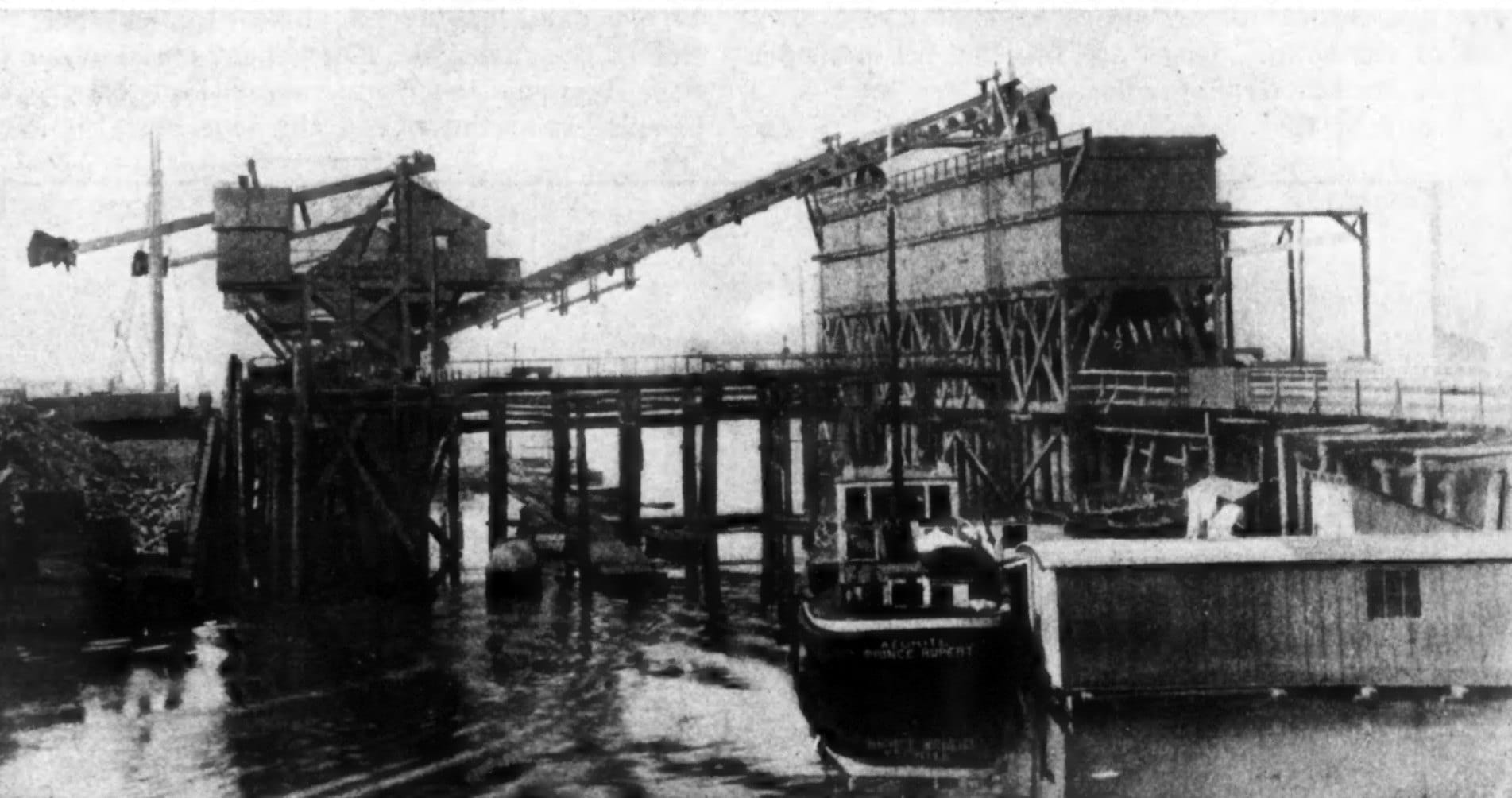
“Standing on the deck of the steamer as it enters the bay and pulls alongside the docks, one is confronted with a busy scene.” That is how the Engineering and Mining Journal carried its readers into Anyox in October 1917. Step aboard. The steamer has come 550 miles up the coast from Vancouver and 35 miles up Observatory Inlet into Granby Bay: four and a half miles of deep, landlocked water under timbered mountains, with glaciers on their crests in every season. The water is so deep that the docks run along the shore and ocean-going ships tie up at low tide. The tide rises and falls as much as 23 feet 4 inches.
Along the shore runs the main dock, 800 feet long, with two tracks, three sets of travelling ore bunkers and a 50-ton derrick for the heavy machinery. At the second dock, belt conveyors carry ore and flux from the unloading wharf into a row of receiving bins, and a third dock, 590 feet long, is going up. In 1916, 316,915 tons crossed these wharves: coke, ore, limerock and merchandise. A fleet working for Granby, three cargo steamers, two tugs, eight barges and two scows, brought coke from Tacoma and Vancouver Island, limerock from Swamp Point and quartz from Maple Bay. Passenger steamers made the run from Vancouver and Victoria every week, 40 to 50 hours each way, and the mail came three times a week.
The man showing the readers around was Wakely A. Williams, Granby’s superintendent of smelters, in charge of both of the company’s smelters, at Grand Forks and at Anyox. Over three weeks, the mine on 13 October, the smelting works on 20 October and the power plant on 27 October, he walked them through everything Granby had built at the head of a northern inlet, and he counted it: the lockers, the showers, the tons, the volts. With his words came fifteen photographs. Most old photographs of Anyox carry no date. These fifteen were in print by the end of October 1917.
A century later another witness came up the inlet, and he brought a camera. In June 2017 Frank Schlichting spent a week at Anyox, filming the ruins from the air and the old workings underground, and he went back in 2018. “It’s just a huge site,” he says, “the most awesome place that we’ve actually ever visited.” Williams wrote for mining engineers, and he described a works at full blast. Frank’s lens shows what the forest left. Laid side by side, the two records answer each other across a hundred years.
In 1917 Anyox was in its sixth year of active operations. Granby had bought control of Hidden Creek in 1910, named the town in 1911 and blown in its smelter in March 1914, and in the fourth year of the war the works were running hard: about 75,000 tons of ore through the smelter every month, roughly 65,000 of them from Hidden Creek. The province’s own figures come out close. The mine sent out 711,656 tonnes that year, more than in any year before it.
A Town Between the Wharves and the Mine
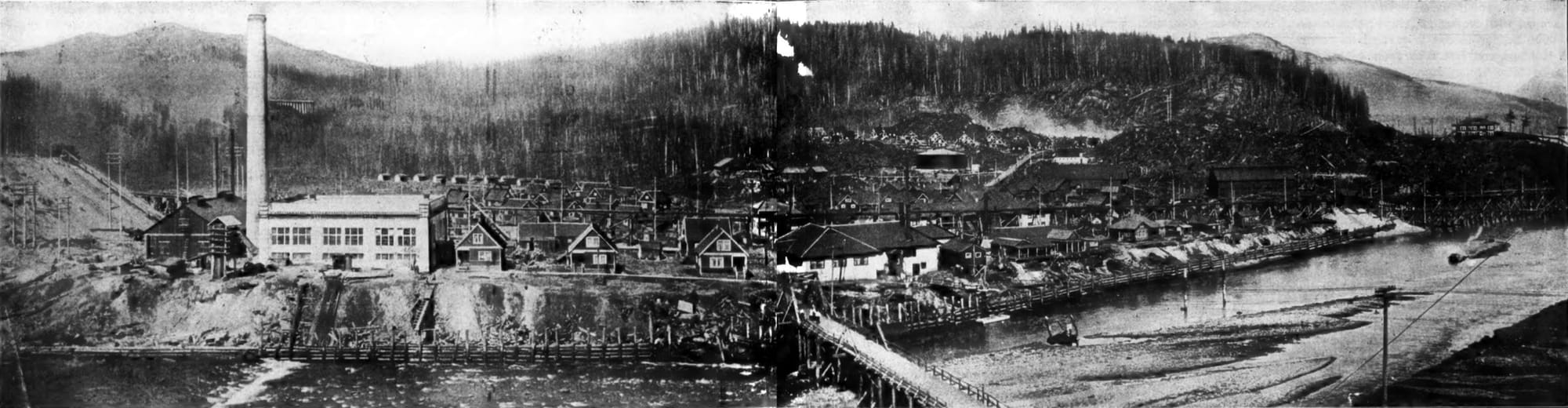
“The town of Anyox is built on the ground lying between the wharves, the smeltery and the mine,” Williams wrote. “The streets are laid out to conform to the contour of the ground and at night are well lighted by electricity.” For a company town at the edge of the map, it was astonishingly complete. There was a hotel of 45 rooms with steam heat, hot and cold water and a telephone in every room, and a hospital with “the latest X-ray apparatus,” three physicians and a staff of nurses. There were moving pictures, a dance hall, pool and billiard rooms, a department store that sold everything from dry goods to meat, an up-to-date café, two schools and three churches.
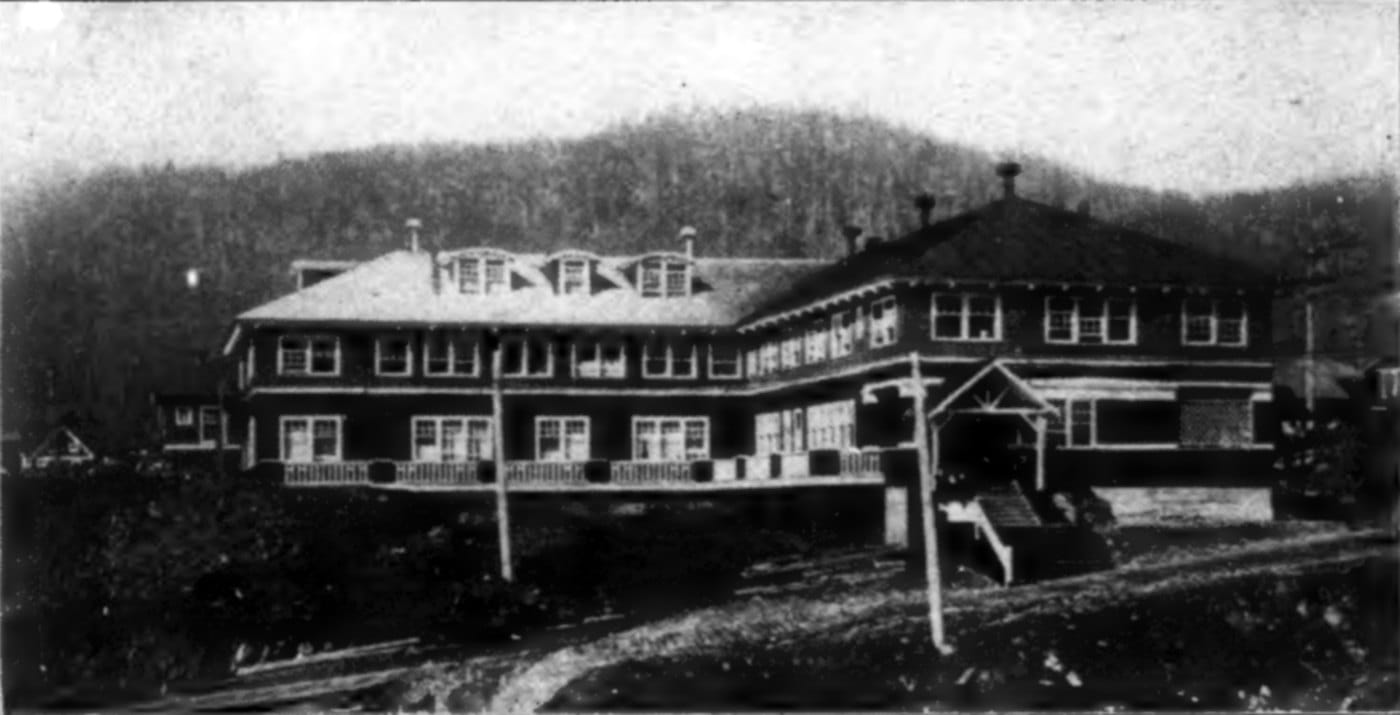
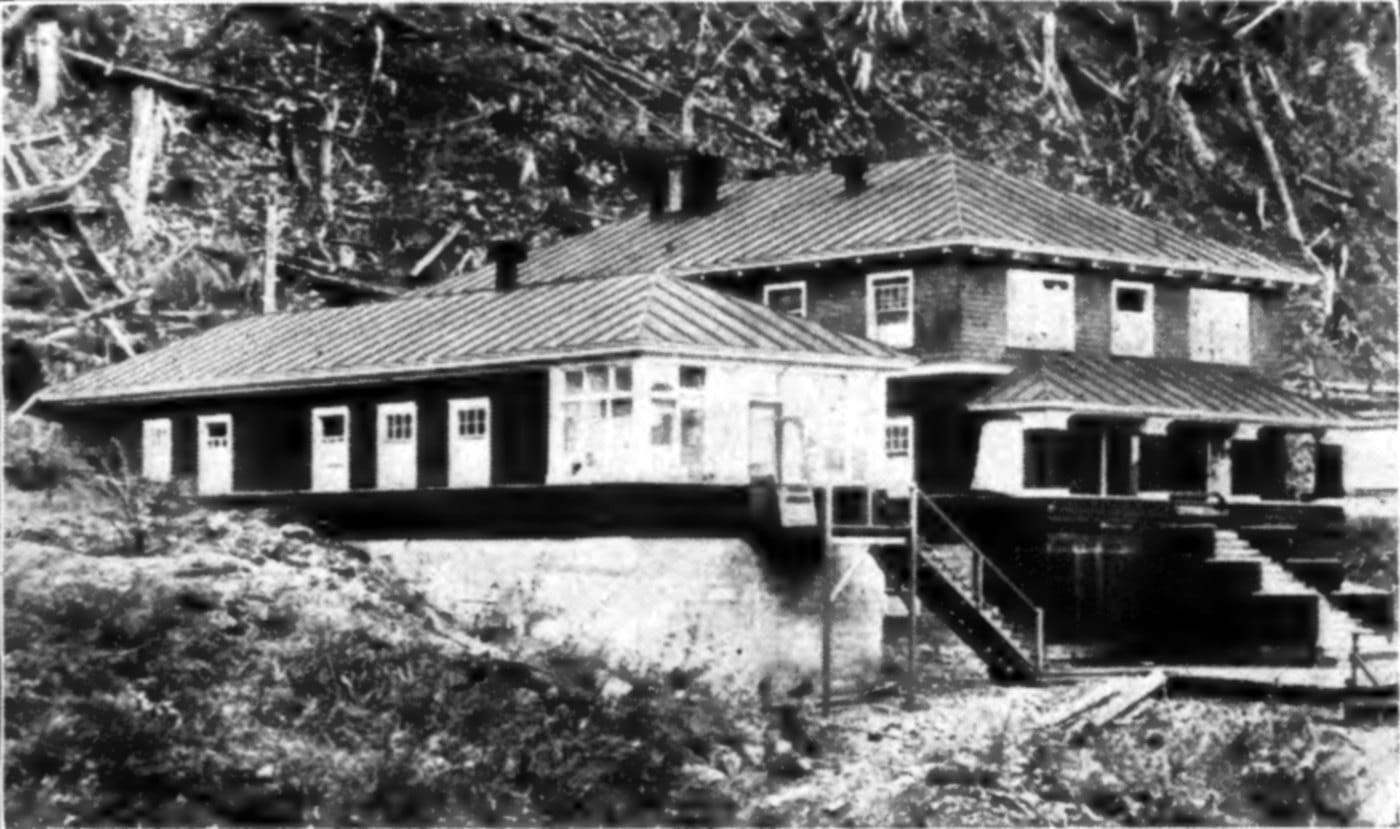
The Granby Bay Hotel, “a modern and attractive haven for visitors,” and the company hospital, 1917 · Engineering and Mining Journal, 13 October 1917
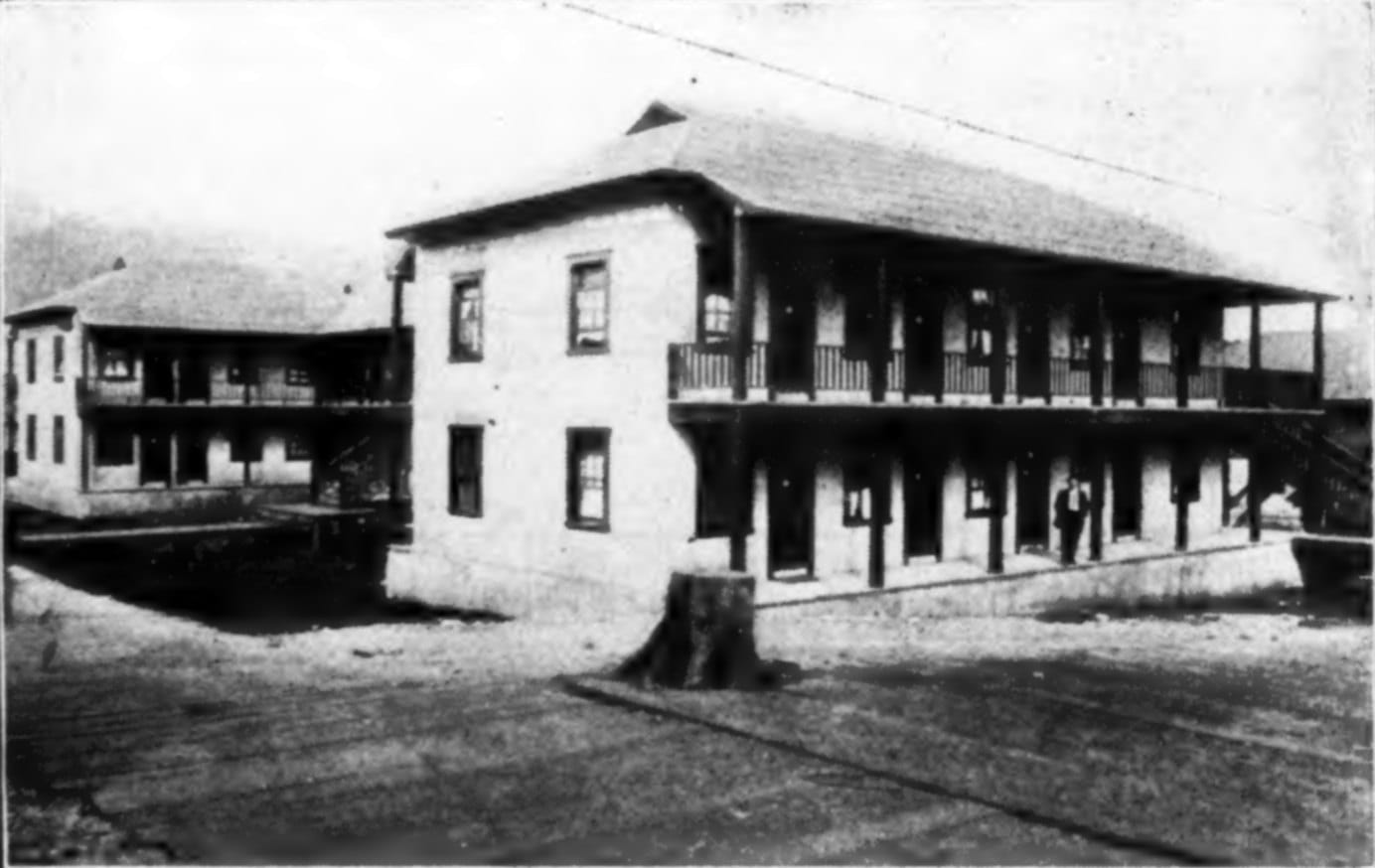
The single men lived in two rooming houses of concrete, fireproof, with no hallways: every room had its own door to the outside, and its own hot and cold water, steam heat and electric light. They ate in a concrete boarding house that seated 216 at a time, with its own bake shops, cold storage and laundry.
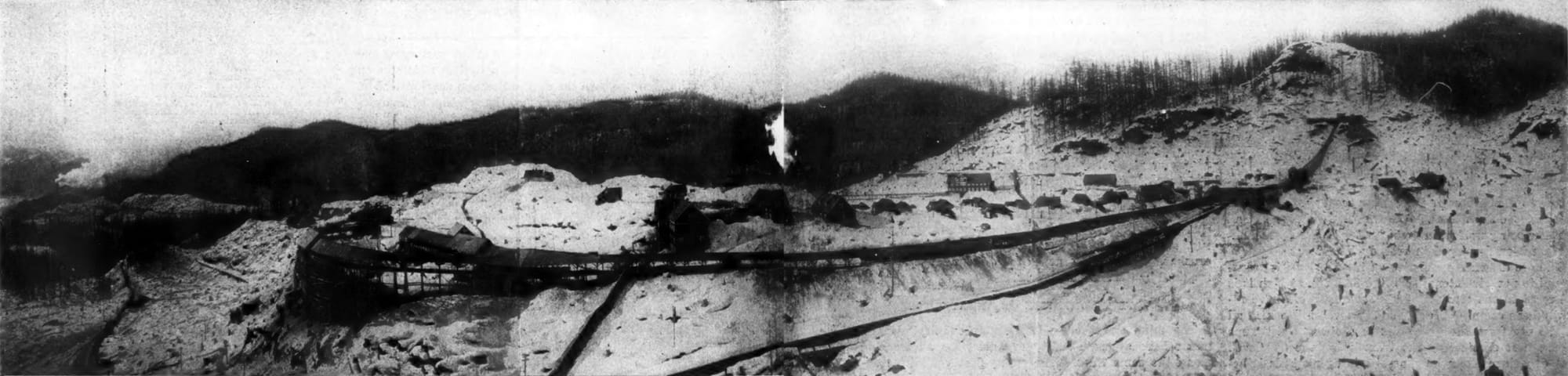
The journal’s widest view of the town was printed across two pages. It looks over Falls Creek to the steam plant under its tall stack, and to rows of company houses climbing toward a hillside of bare, standing trunks.
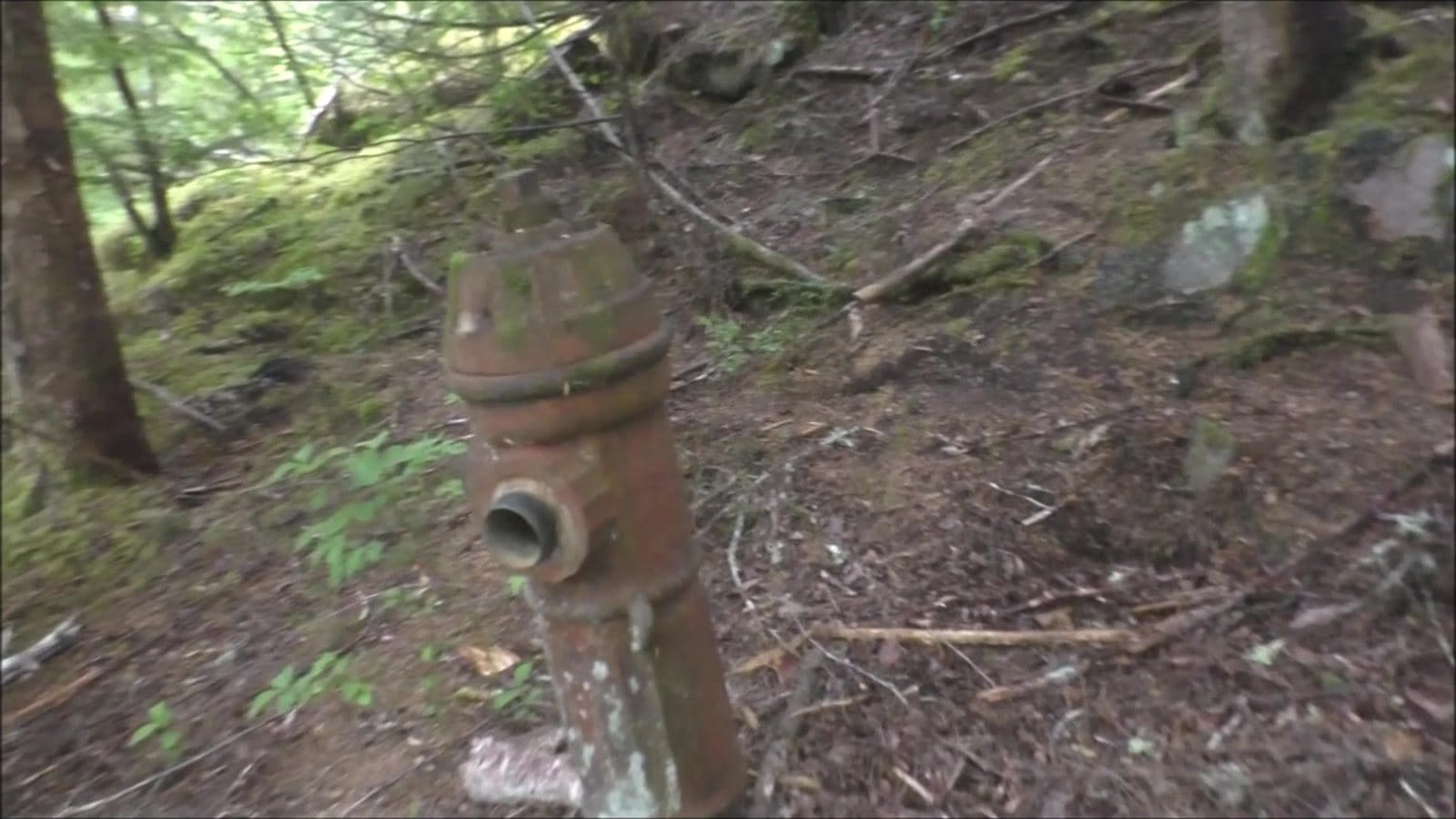
Almost all of it was wood. In early July 1942 lightning set the dead forest alight, and the fire took the plank roads, the houses and what was left of the town. What stood afterward was concrete, brick and steel. Then the forest came back, and Frank found the town inside it: fire hydrants standing among the trees, “where you’d never expect them.” “It was a very modern town in every respect,” he says. “They had cold and hot running water, heat, everything in each house, bunkhouses and stuff.”
Up at the Mine
The mine had a town of its own. “Since starting active operations in 1912, a new mine town has been built,” Williams wrote, and its heart was the change house: three storeys of frame, with 300 steel lockers, a washroom where 50 men could wash at once, 24 showers, four porcelain tubs and a drying closet for clean clothes. Above them were a pool room, a library and reading room, the shift boss’s office and an emergency hospital of four beds. The top floor was a dance hall. A man could come off shift, shower, and climb two flights of stairs to the dance floor.
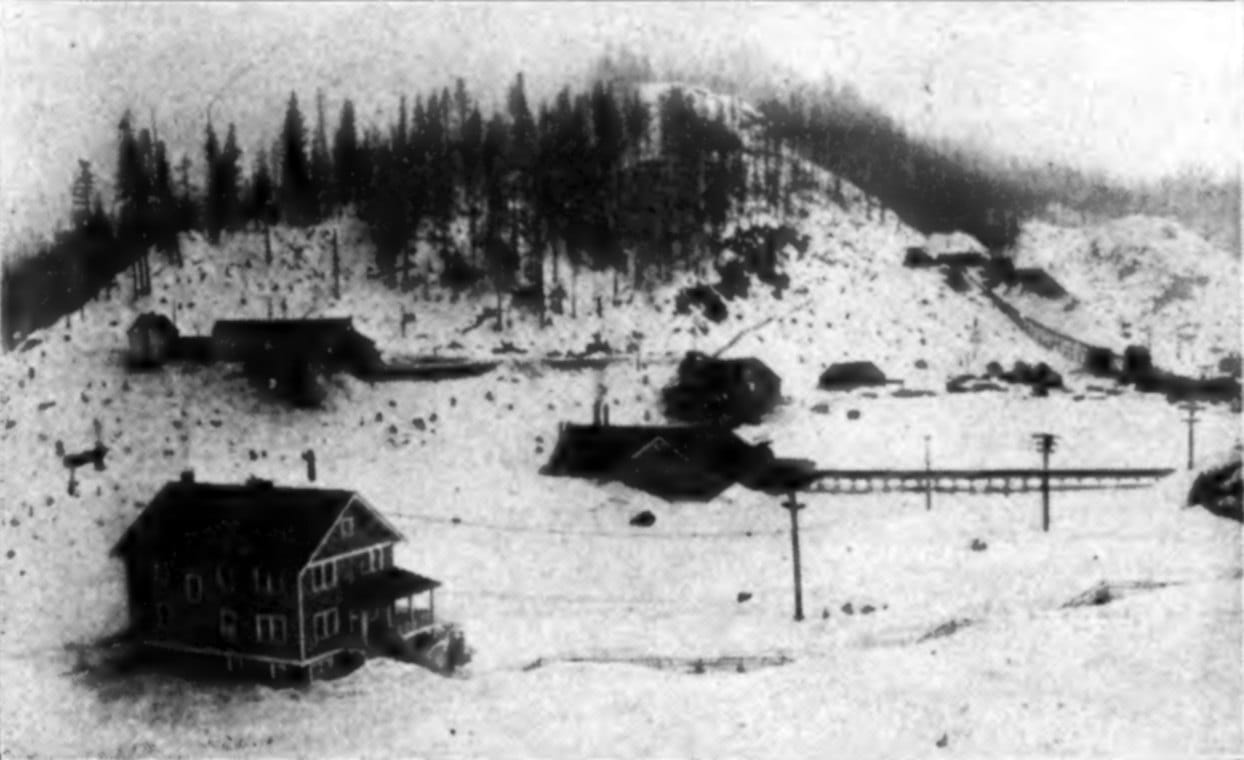
The bunkhouse had three wings and beds for 400 men, and each of the 50 cottages had a porcelain bath, hot and cold water and electric light. Williams made a point of the drains. “The importance of the sanitary arrangements of the town, including sewer system, incinerators for garbage disposal and an adequate water system,” he wrote, “is evidenced by the fact that sickness caused by the lack of these things is unknown.”
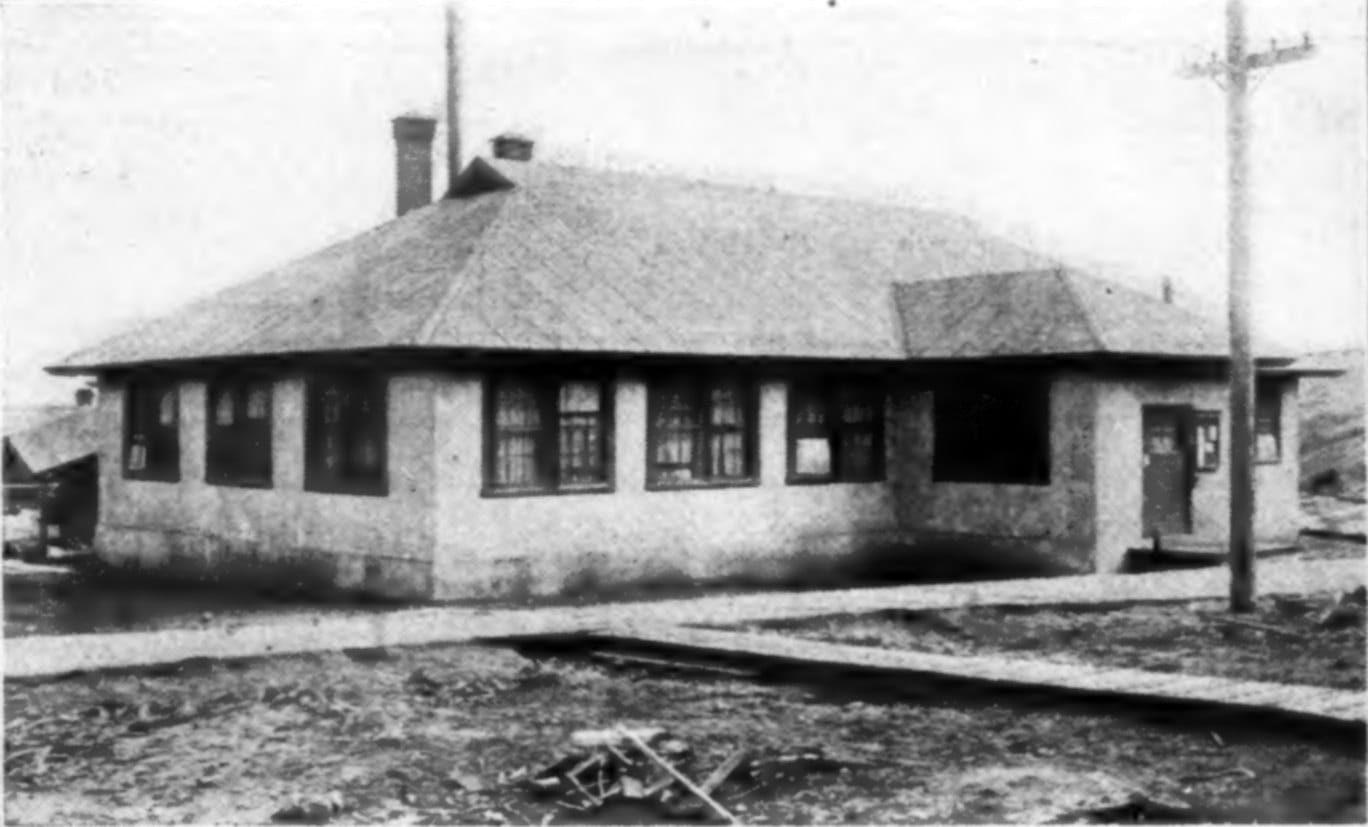

A Granby mess house, and a row of the company’s family cottages, 1917 · Engineering and Mining Journal, 13 October 1917
Above the camp, the hillside was the mine. Williams counted five orebodies, first opened by six tunnels. Near the surface the ore came out of glory holes: stopes driven up to daylight and widened at the top, so that the ore broken above could be drawn off from below. By 1917 there were two in No. 2 orebody and two in No. 1. They would grow into great pits, and in November 1934 a single enormous blast joined two of them and, in the end, broke the mine.
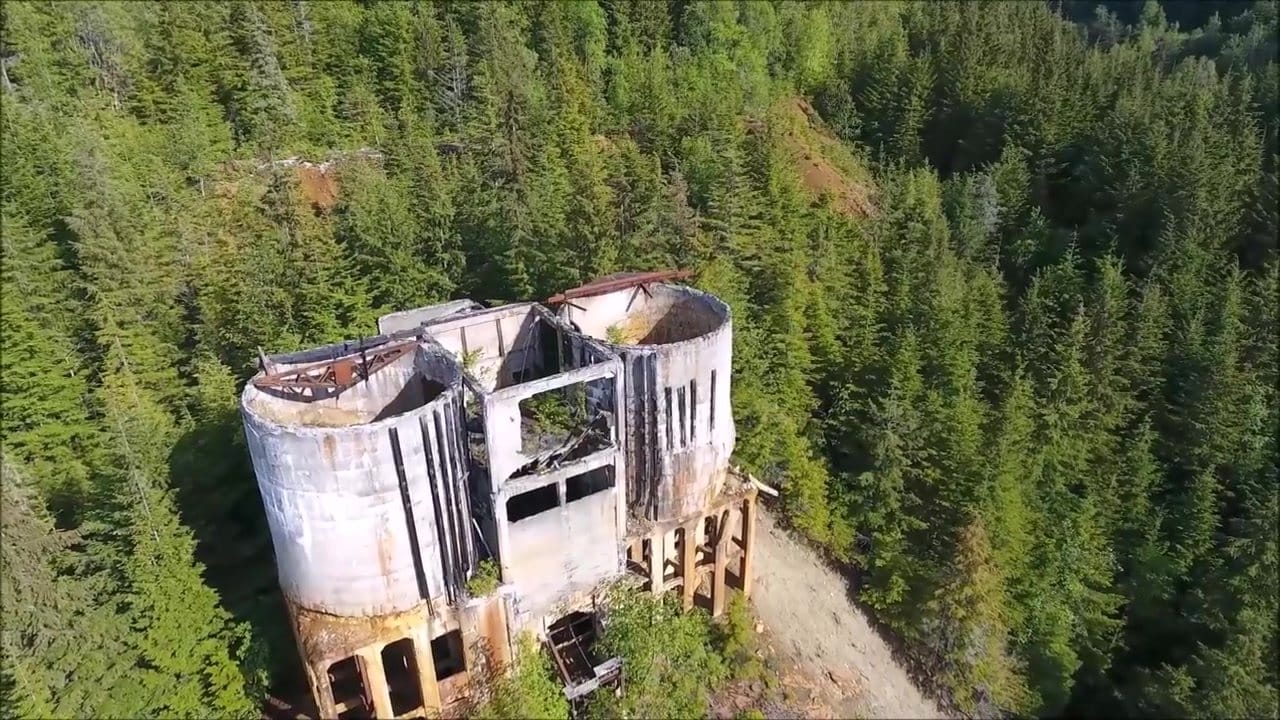
In 2017 Frank flew his drone over the pits. Below them, deep in the forest, it looked down on a pair of round concrete bins with a square room between them, where full-size ore trains once ran across the top and dropped their loads. “I’ve never seen ore bins made out of concrete,” he says, “but they don’t normally ever run a great big full-size train on top of them either.” The journal of 1917 puts the mine’s surface crusher “below two ore bins of a capacity each of 250 tons.” Whether these are those two, or a pair built later, the record does not say.
Inside Hidden Creek
Underground, the ore moved on rails: in 1917, 54 Granby cars on narrow track behind five small electric locomotives, and a heavier line going in for the bigger cars the growing smelter needed. The Granby car, named for the company, tipped itself to unload. Frank found one of the ramps that tipped them, still in place.
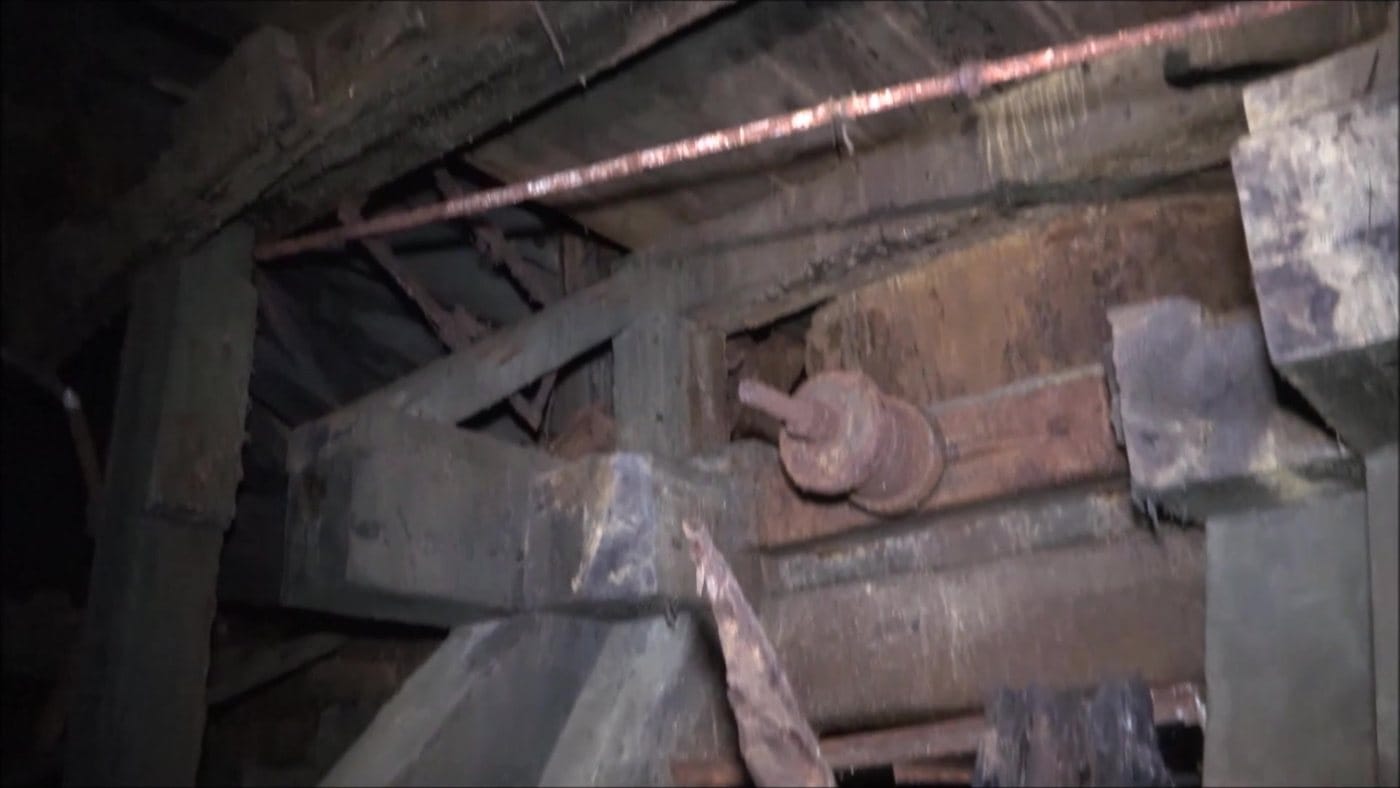
Everything that came out of the mine had to be broken small enough for the furnaces. Granby built two crushers, “so that either plant can take care of the maximum output.” One stood at the surface. The other was down in the mountain: a Bacon-Farrell crusher, fed by ore dropping from the level above and spilling its broken rock down to the level below, where the railway cars were loaded for the smelter. The rule for both was simple: “The ore is crushed to 8 in. which is the size required by the smelting works.”
A century later Frank’s light found a crusher in the dark, still standing in the mine where it was assembled, too big ever to be taken out. “There’s a big rock crusher that crushed everything that was over 8 in. in diameter,” he says. “It’s about four stories high.” His camera climbs it beam by beam, past timbers a foot square, rotting stairs and iron scaled with rust. At its foot he and a partner stop at two great wheels, one on either side, and reason out how it was driven: a big motor above, they decide, turning both wheels with belts, and lifted out when the mine closed. The journal of 1917 had answered them a century before. Each of the mine’s two crushers was “belt-driven by a 150-hp.” Westinghouse motor, with pulleys “on either side of the crusher.” Whether this is the crusher of 1917 or one that took its place, the record does not say. Frank’s eight inches and the journal’s are the same.
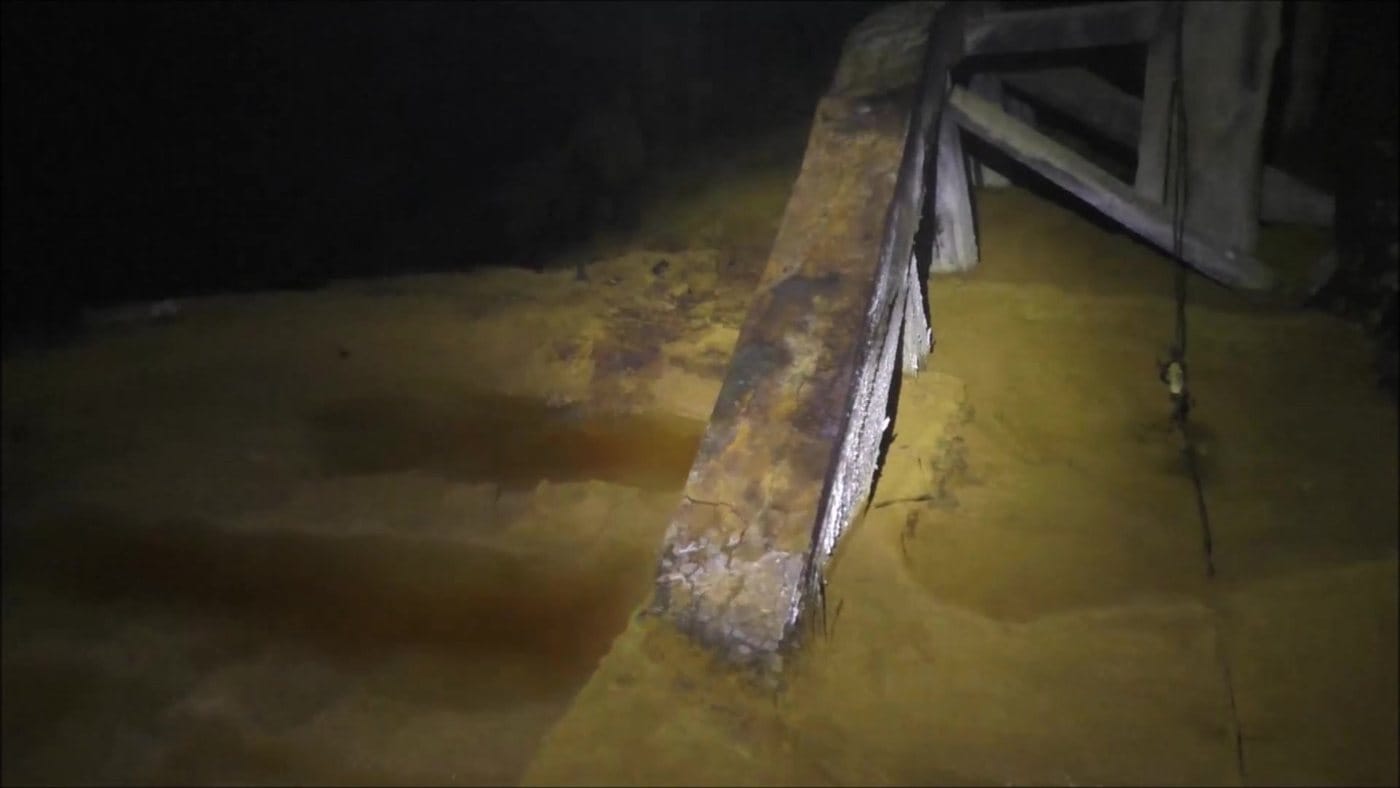
The mine is flooded and caving now. Its timbers and ladders have grown heavy with the minerals that soaked into them, and the floors of its drifts lie crusted yellow under standing water. In 1917, “the mines and all the houses are lighted by electricity.” In the water of a drift, Frank’s light found a green enamel lamp shade.
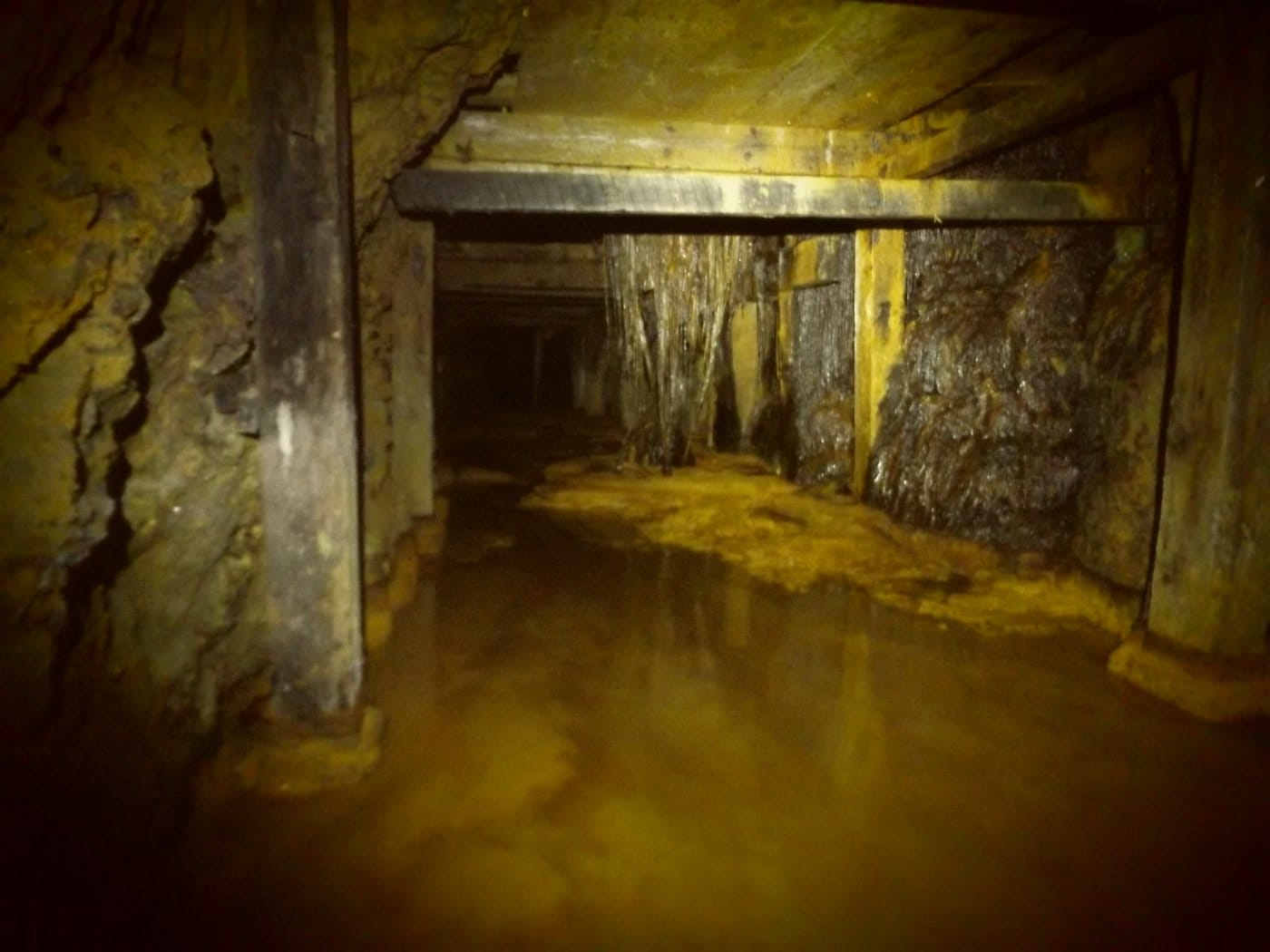
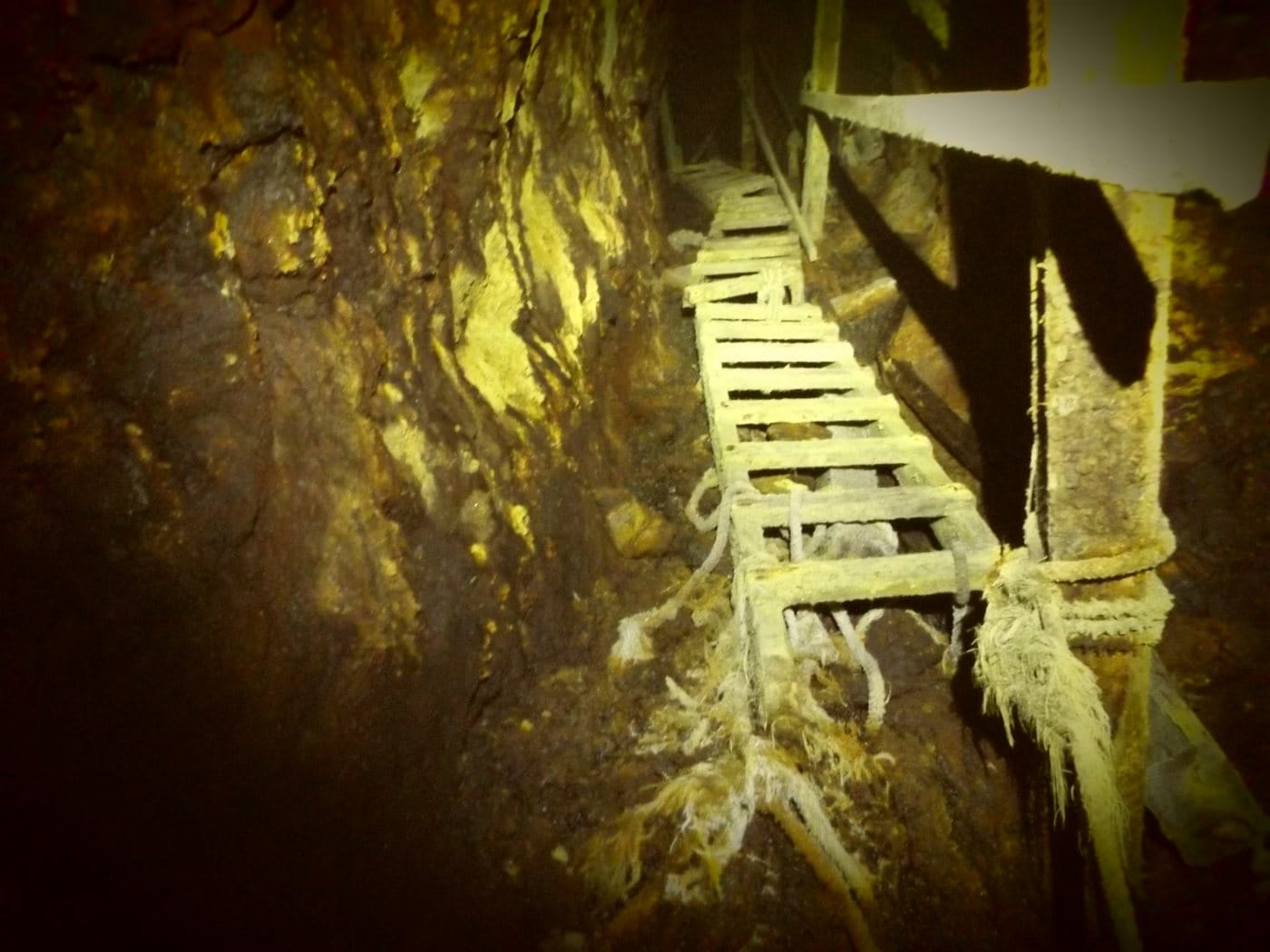
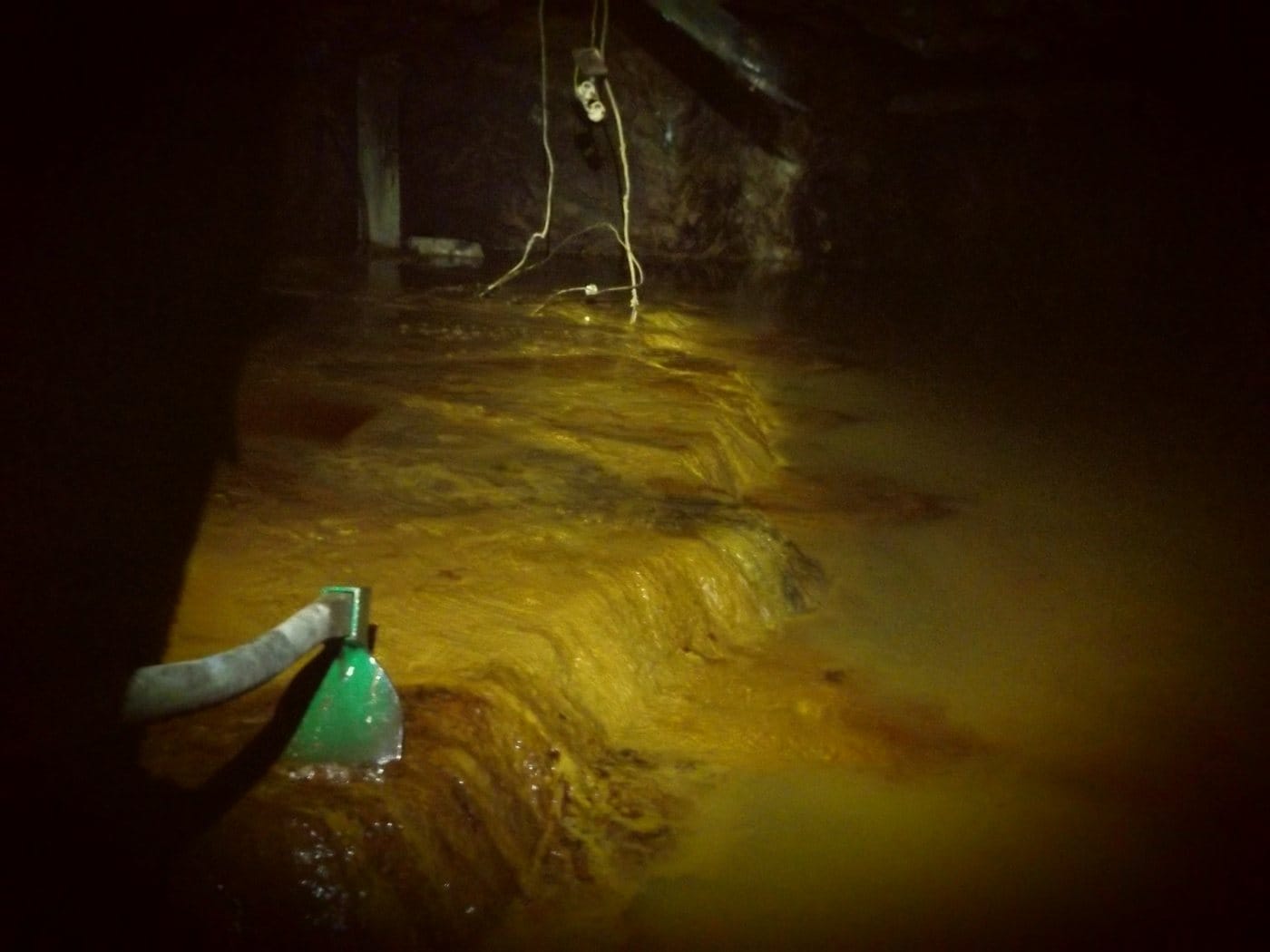
Inside Hidden Creek today: a timbered drift, an old ladder hung with minerals, and a lamp shade in the water · Anyox · Frank Schlichting’s photographs
Safety First, 1916
Williams gave safety a section of its own, and it reads as the most modern part of his three articles. Granby’s safety-first committee “held its first meeting, Apr. 3, 1916,” and met every month after that, with a subcommittee of the men themselves under each department head, changed every two months. Any man could point out a danger to a committeeman or the safety engineer, or write it out for the suggestion box. Sixty-five men had been taught first aid. There were seven first-aid stations, 14 bulletin boards with notices changed every two days, and danger signs at the railway crossings, the powder houses and the high-voltage lines. Letters on safety went to the homes of all the married men every month or six weeks.
It seemed to be working. Time lost for each accident was down a third on the year before, and in the first three months of 1917 the hospital treated 64 per cent fewer accident cases than in the same months of 1916.
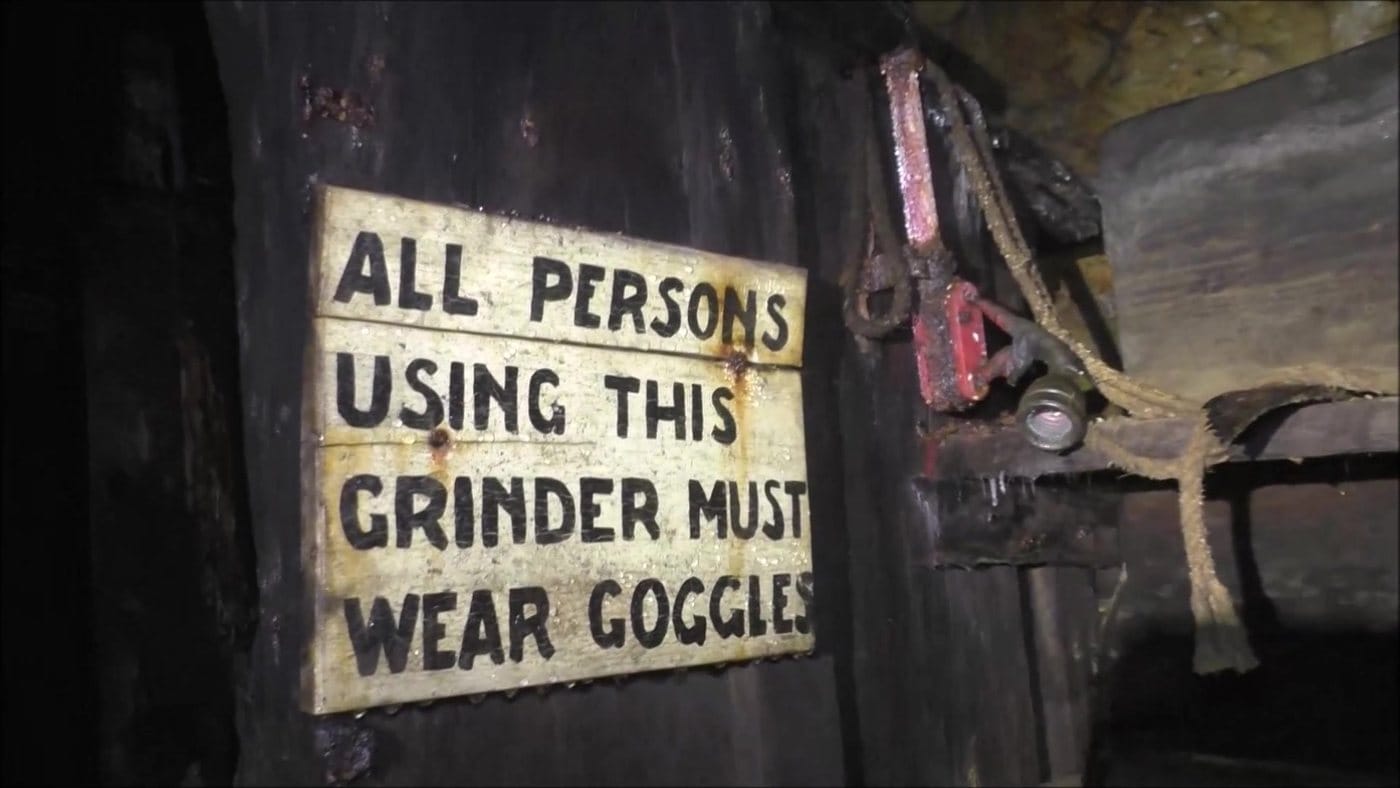
Some of the signs are still down there. On a timber wall underground, Frank’s light picks out one lettered black on white: “All persons using this grinder must wear goggles.” When it was painted, no one can say.
A Thousand Men
“There are about 1000 men employed at the Anyox unit, 450 at the mine and 550 in all other departments,” Williams wrote. “Labor of all nationalities is employed, the majority of the men being British subjects.” He named the men in charge: F. M. Sylvester, the general manager, in Vancouver; O. B. Smith, superintendent of mines; A. J. Bone at the smelter; E. E. Campbell at the Hidden Creek mine. The men who did the work he did not name.
At Full Blast
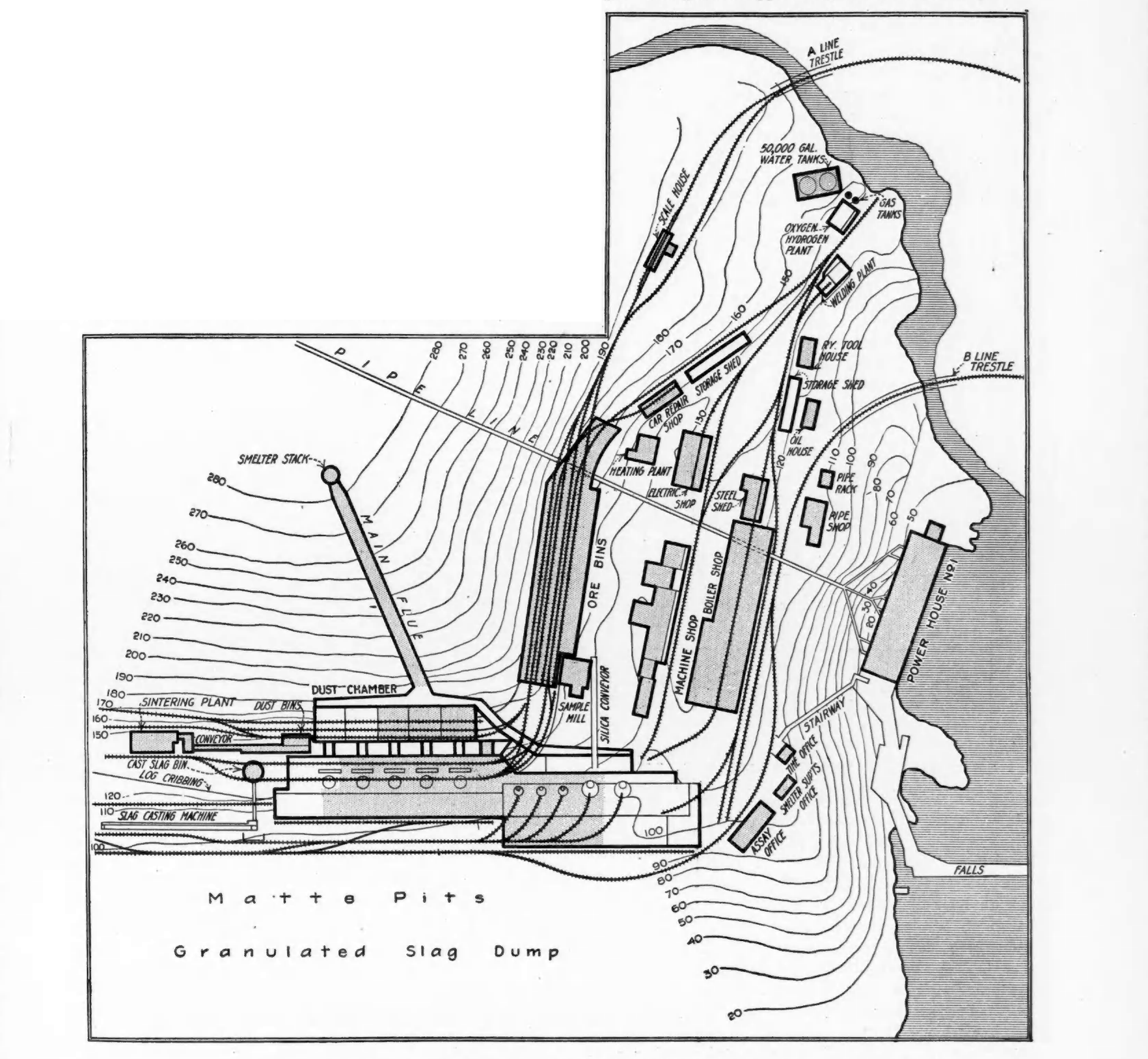
At the centre of it all was the smelter. Granby put it at Anyox “primarily to treat the ores from its Hidden Creek mines,” on ground chosen with room to spare: “there is room at the site selected for 12,000,000 to 20,000,000 tons of granulated slag.” Three blast furnaces were built, “later a fourth was added,” and by 1917 about 75,000 tons of ore went through them every month. Most came down from Hidden Creek. The rest came by sea, from Granby’s Midas mine at Valdez in Alaska, from Prince of Wales Island and from the White Horse district in the Yukon, with limerock for flux from the company’s own quarry at Swamp Point.
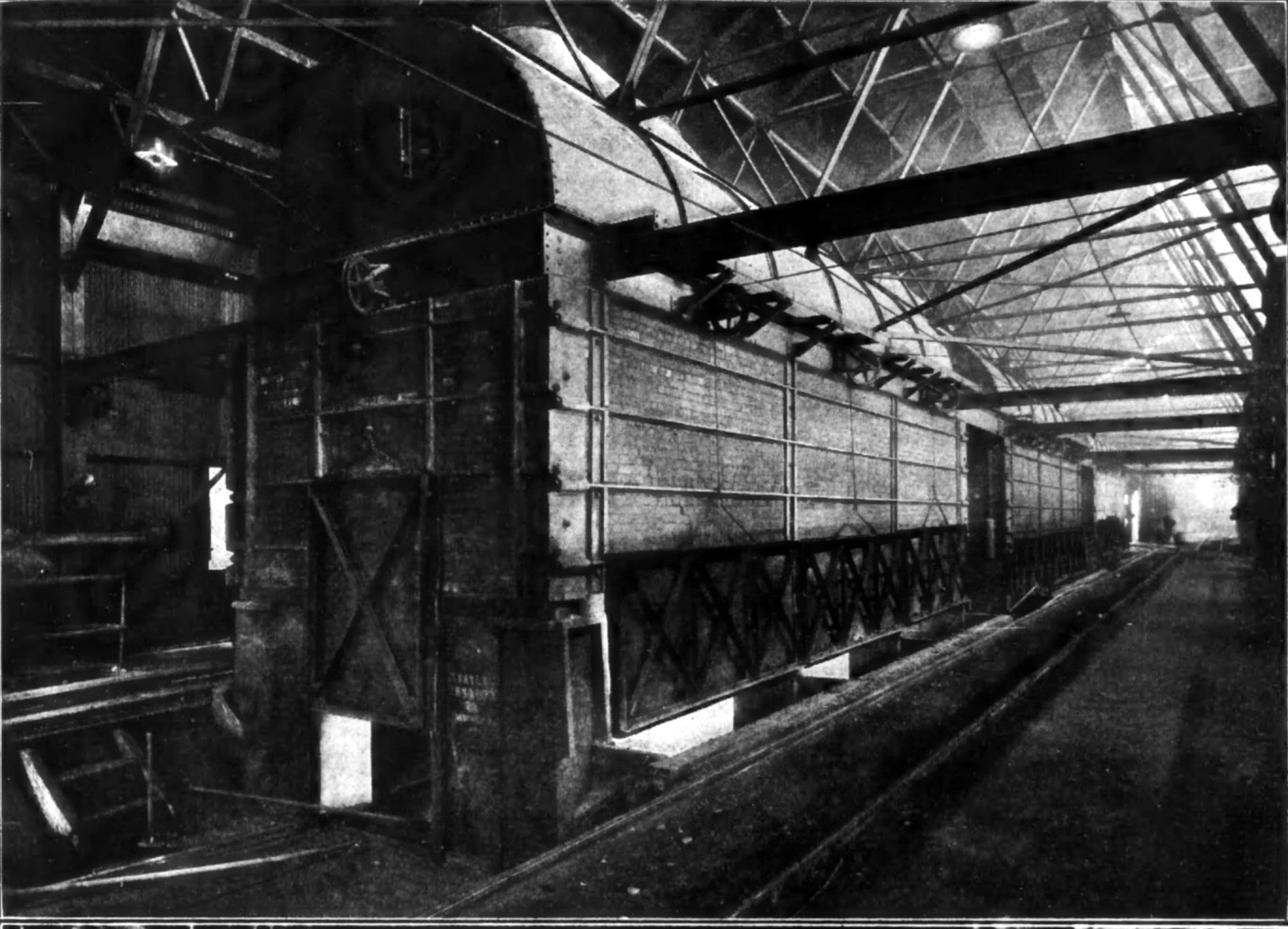
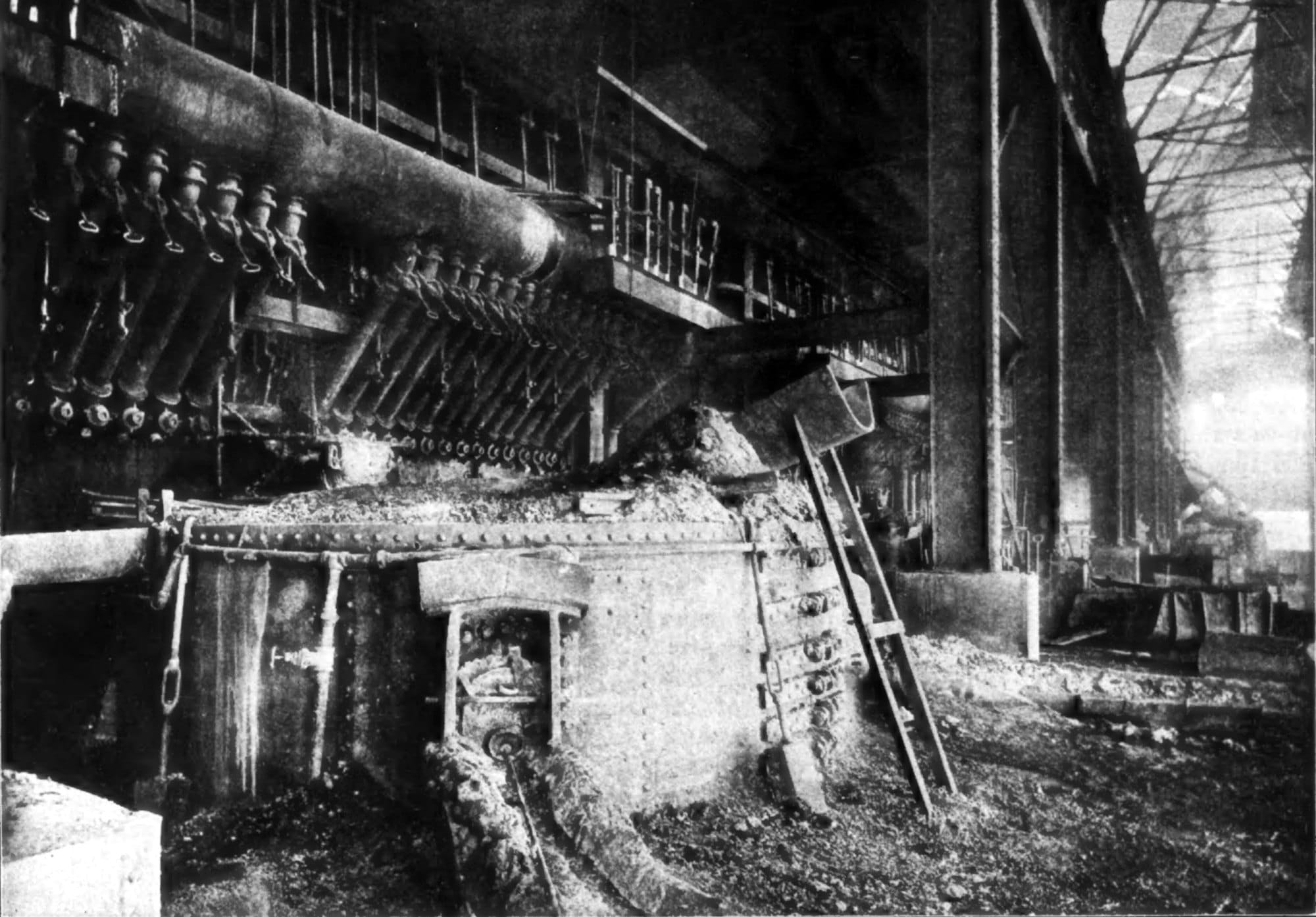
From the furnaces the matte went to the converters, which blew it into blister copper averaging 99.25 per cent pure, and the building was being lengthened for two converters more. In 1917, too, the Vancouver photographer Leonard Frank (no relation) photographed the blast-furnace crew, some eighty men in rows inside the smelter. That print is on the Anyox record.
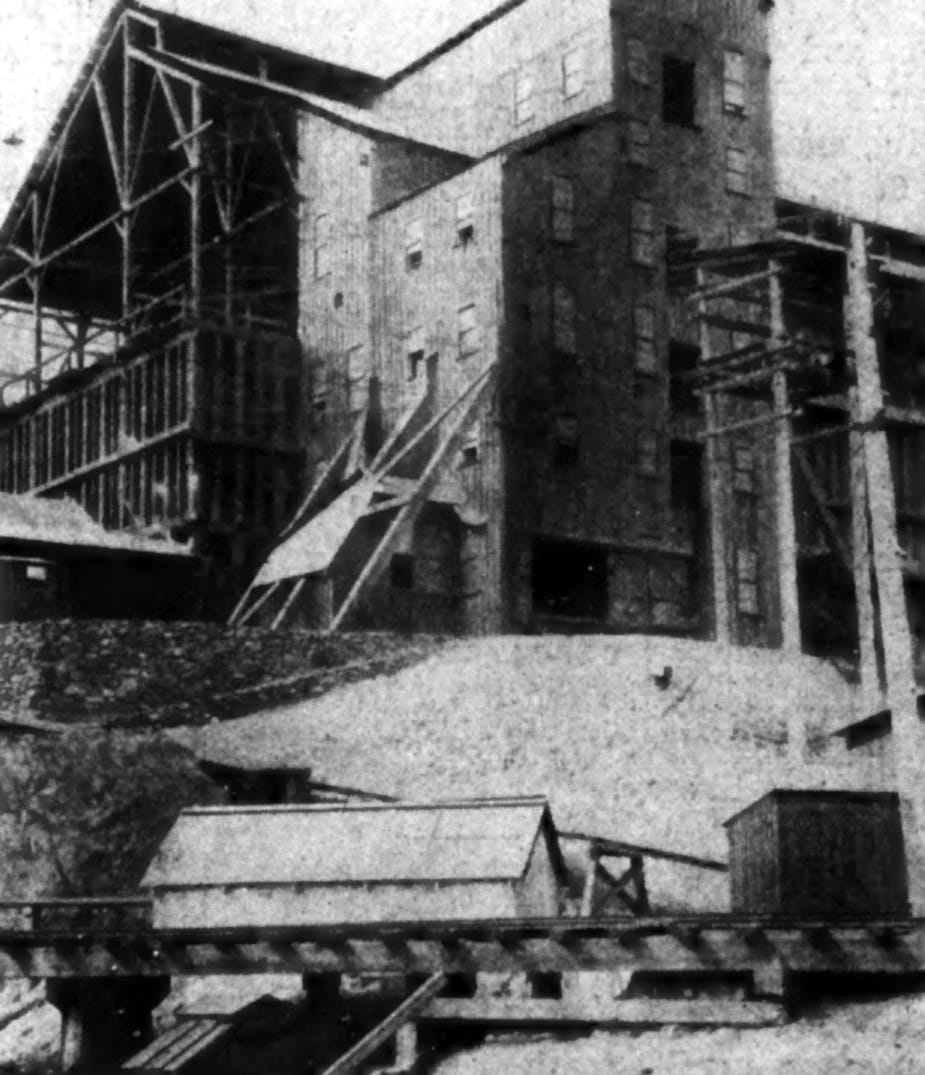
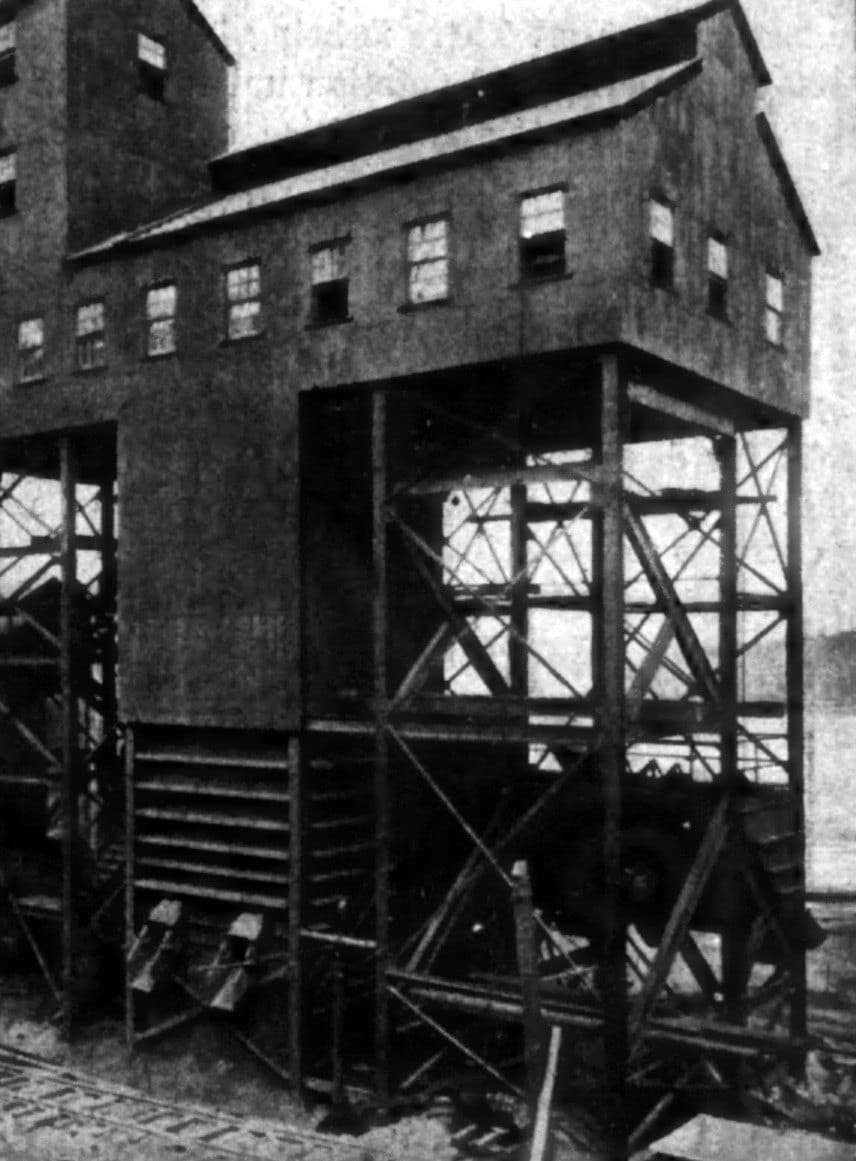
The sampling mill and the sintering plant, 1917 · Engineering and Mining Journal, 20 October 1917
Above the works, a flue 20 feet by 20 ran 400 feet up the hill to the stack: reinforced concrete, 22 feet across and 153 feet high, its top 433 feet above the tide.
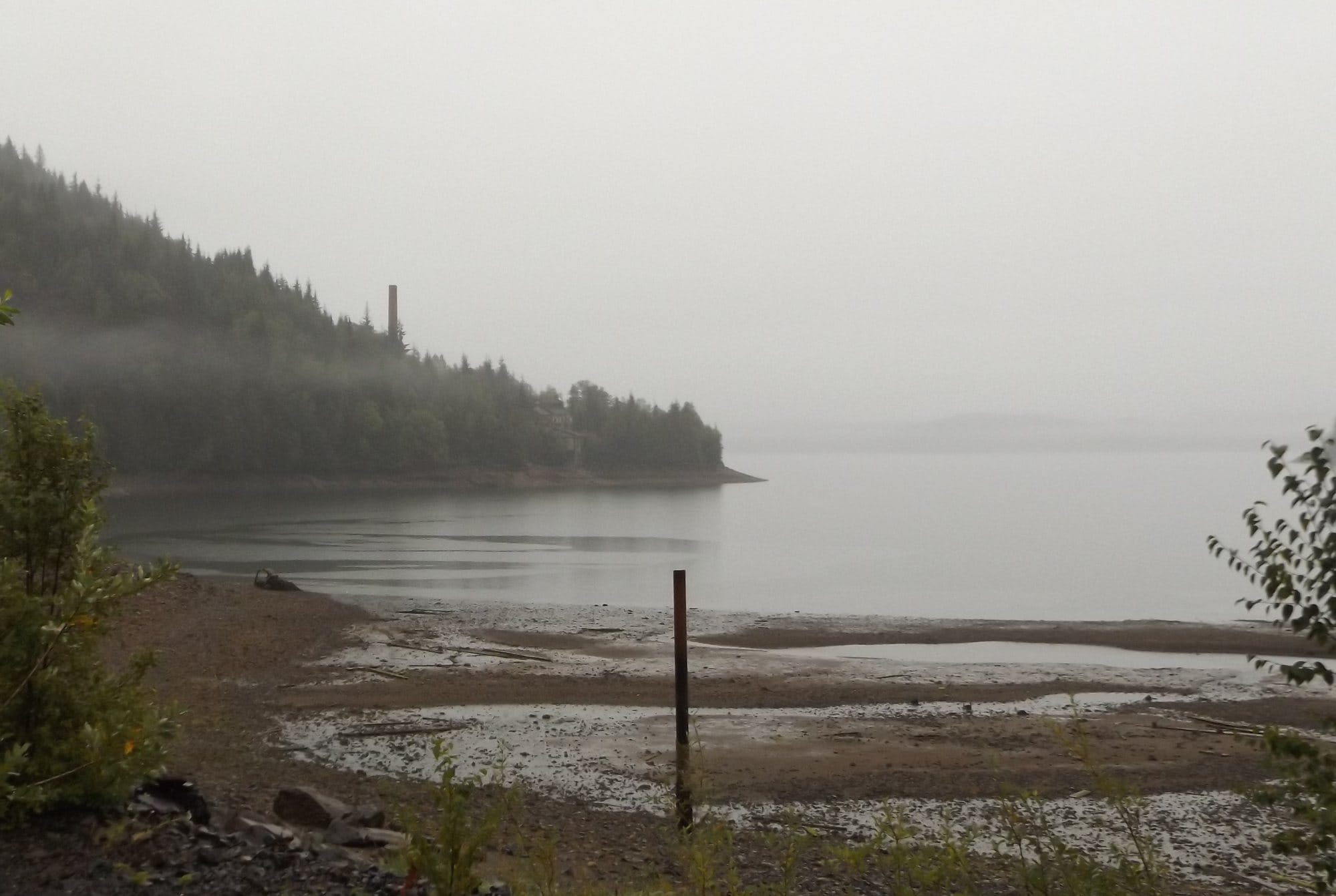
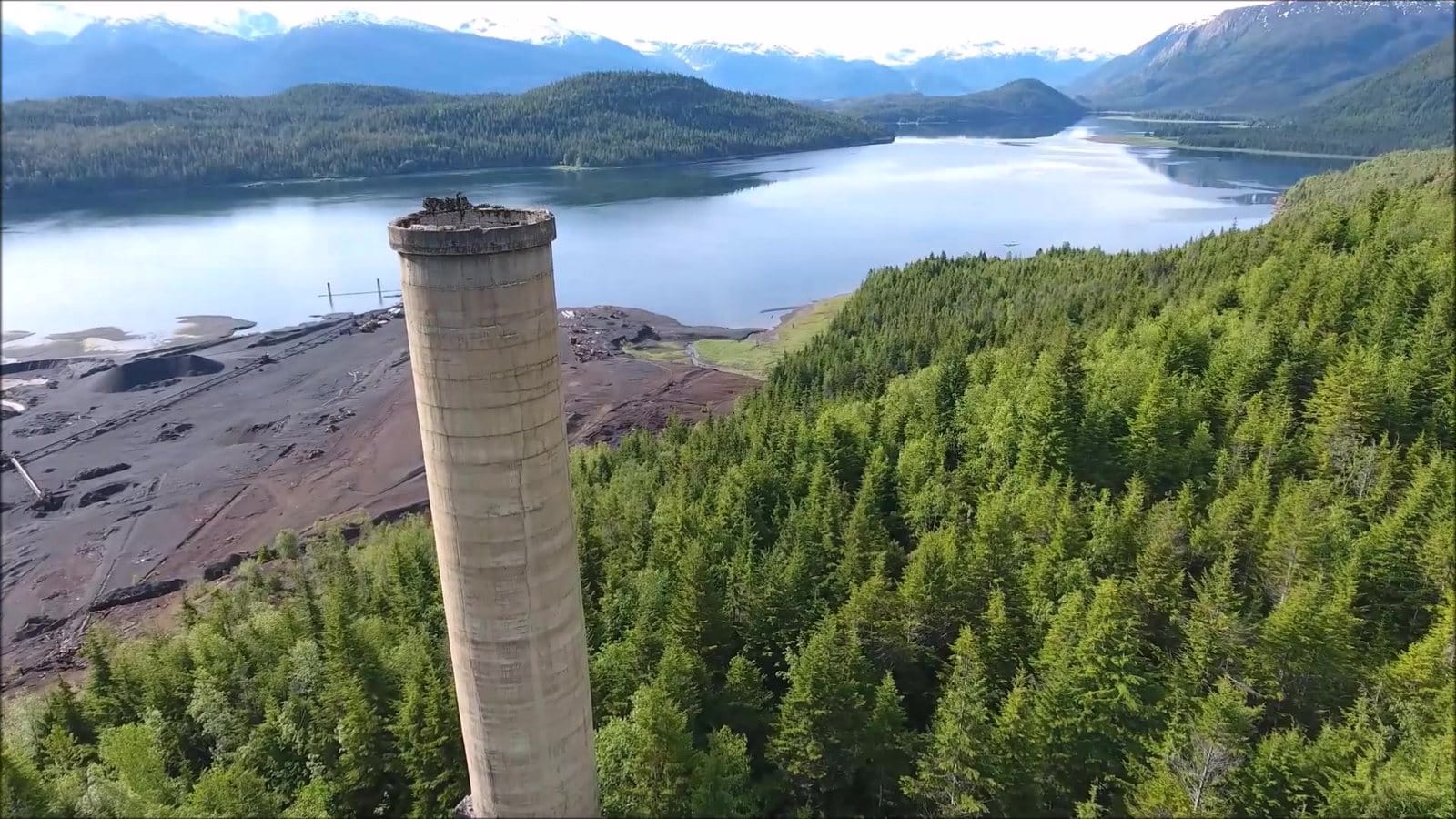
It is still standing. In 2017 Frank flew his drone over it and looked down inside. He put it at “about 22 ft across,” the same 22 feet the journal printed, and he saw what the journal never had to: “you can see daylight through the side of it.” Below it lies the slag the site was chosen to hold, “just a massive pile of slag,” as Frank says from the air, quarried now for abrasive and shipped away by the barge-load. He wonders aloud how many more years the stack will stand.
Power From a Glacier Creek
Everything ran on Falls Creek, a stream that “receives its flow from melting glaciers.” Granby built a crib and rock-fill dam 110 feet high where the canyon narrowed and the creek could be turned over a natural rock spillway, and brought the water down a six-foot wood-stave pipe to a power house near the mouth of the creek, “a brick-and-steel structure and all foundations are on solid rock.” There the water struck the Pelton wheels with a head of 375 feet, and the wheels did everything at once. They sent air to the miners’ drills, blew the blast into the furnaces and converters, and turned the generators for the motors, the electric railway and the lights. The first panel on the switchboard ran the street lights.
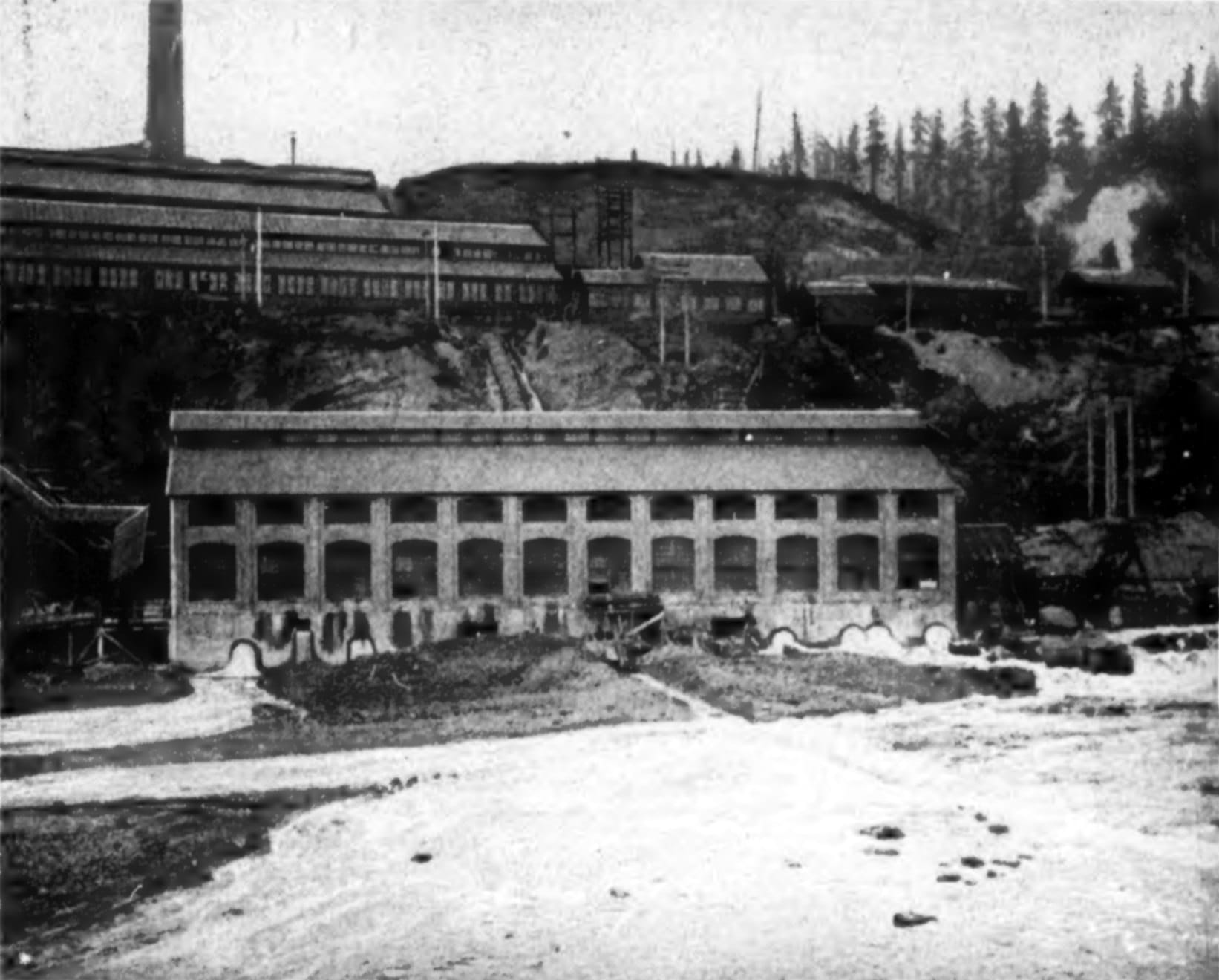
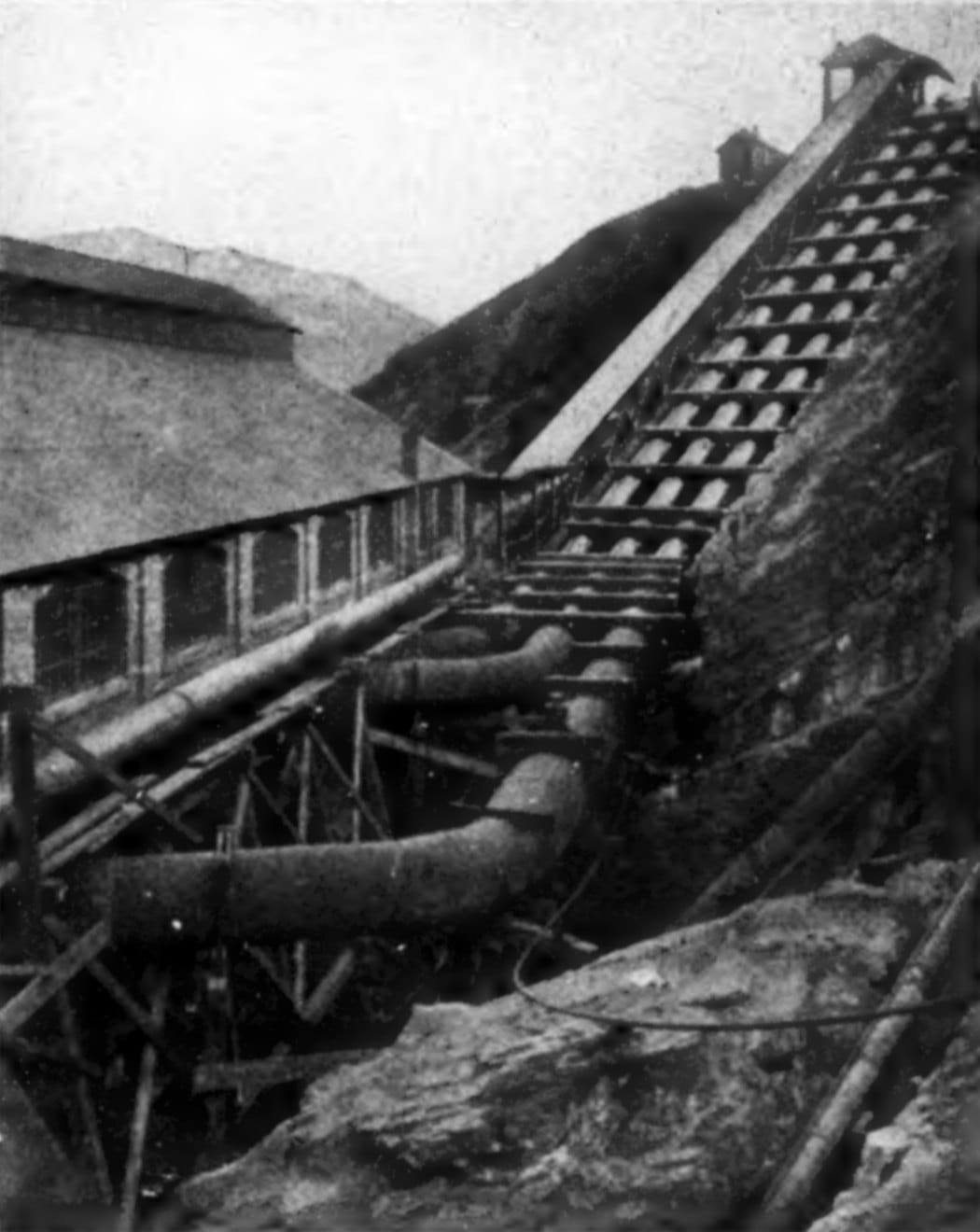
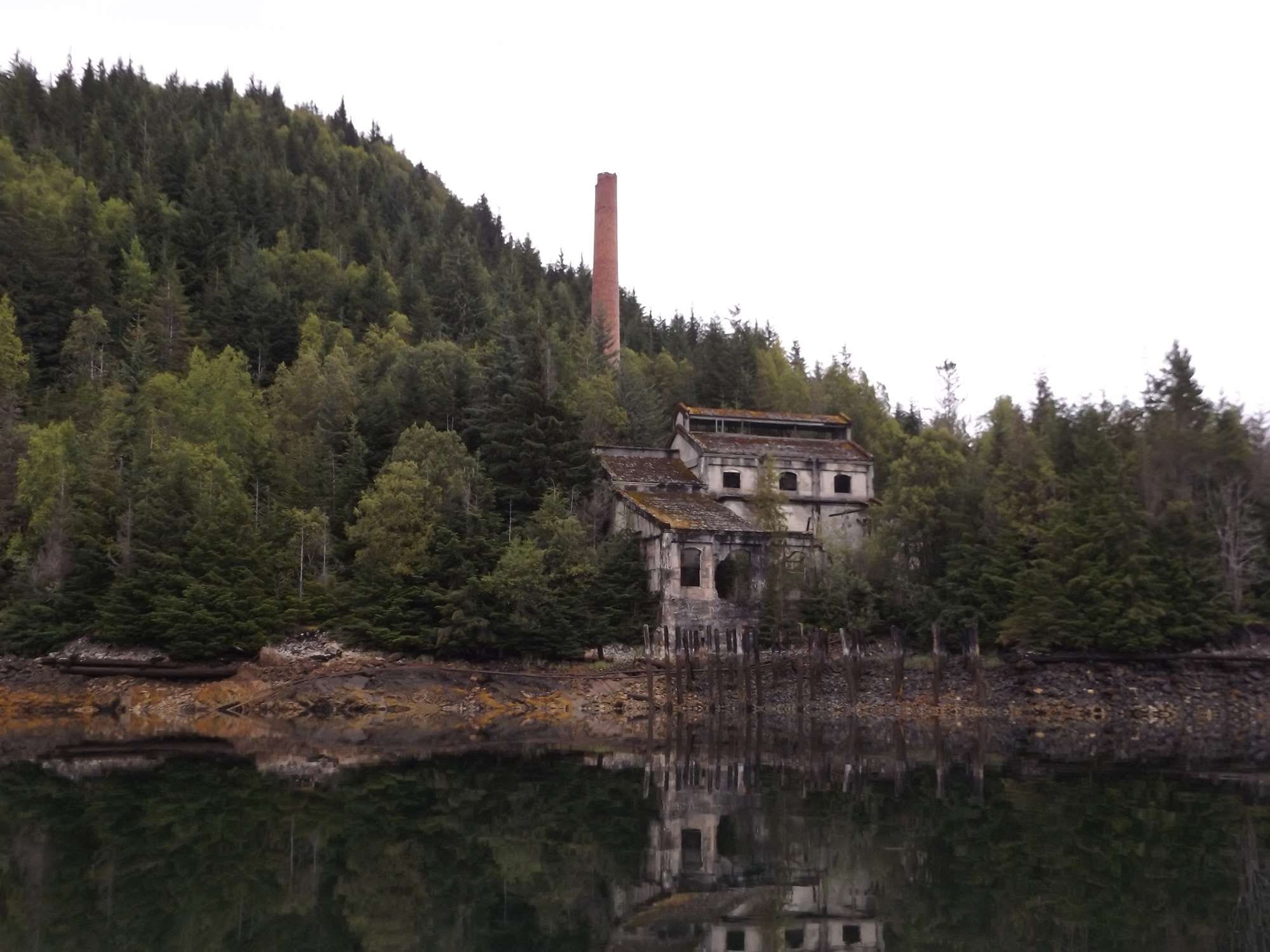
The creek had one weakness. “On account of the glacier feed to Falls Creek, there is a period of three months in the winter of extreme cold, when the flow of water is not enough to give all the power needed to fully operate mines and smelter to capacity.” So across the creek, facing the water plant, Granby built a steam plant of 6,000 horsepower in reinforced concrete, fired by oil. The two power houses stood face to face across Falls Creek, about 300 feet wide there, with their cables strung over the water. Frank tells it the same way: “They also had to have a steam plant, because they couldn’t actually generate enough power in the winter, because just the water flows were quite a bit less.”
A ruined powerhouse still stands on the shore. “Everyone goes up there and takes pictures of it,” Frank says. In 2017 he flew his drone in through one of its windows and out another, past the saplings growing up inside it now. “It just really is an astonishing building in every way. We looked at some really old pictures of it. It was just like spotless.” Which of the power houses it is, the brick-and-steel water plant of 1917, the steam plant across the creek or a later building, the record does not yet say.
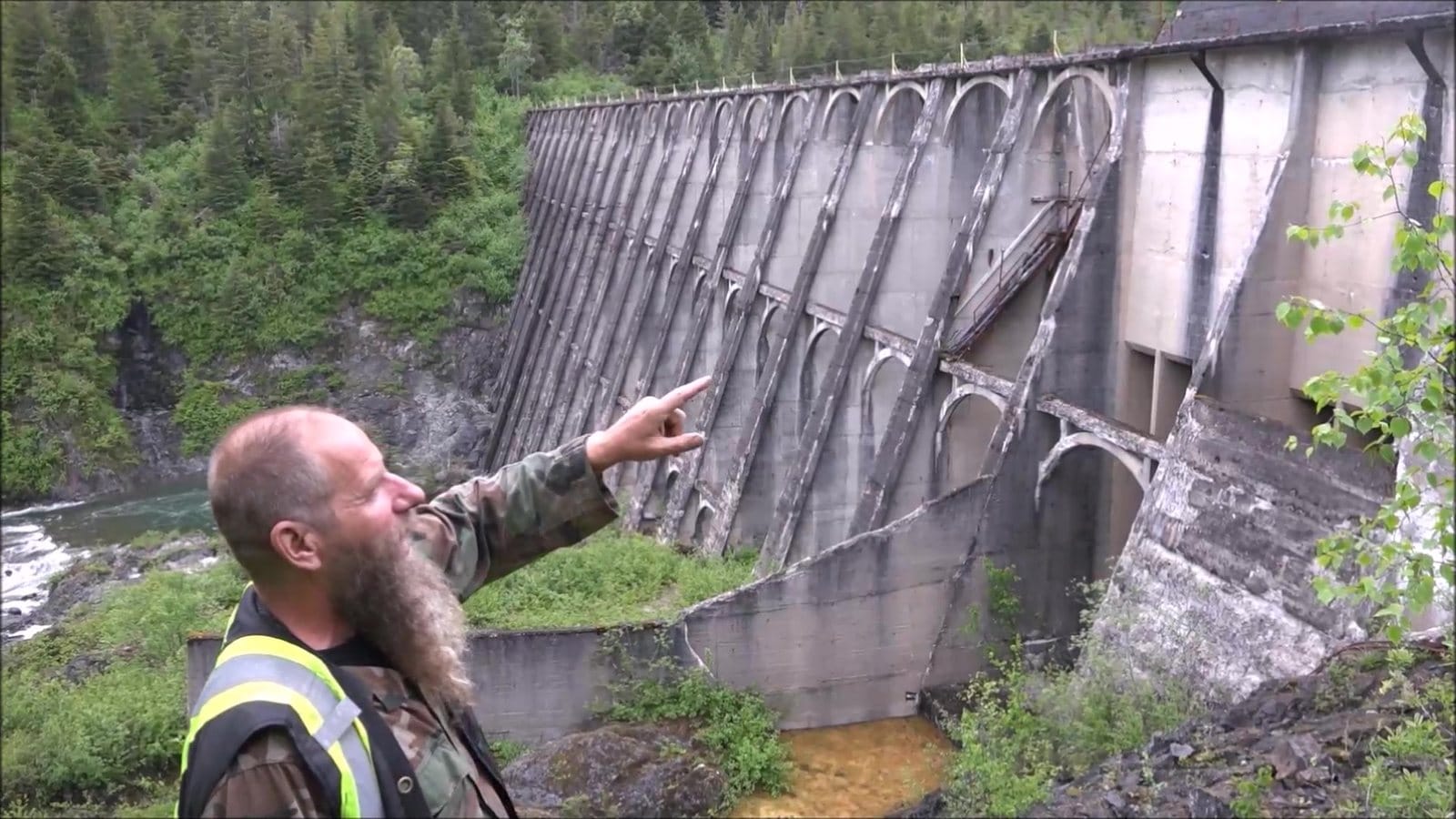
The timber dam of 1917 is gone. In the 1920s Granby replaced it with a concrete dam of buttresses and arches, and that dam still stands up the creek, breached after the closing so that it could never be overtopped. Frank stood beneath it and pointed up at the arches.
Between the mine, the smelter and the docks ran Granby’s electric railway, about six miles of three-foot track, counting the yards. Its 42-ton locomotives brought the ore down in trains of eight and ten 25-ton cars, and Frank found three of the big ore cars still lying on the bank between the crusher and the smelter, each “about half the size of a regular gondola.” What the works could not wait for, they made: a foundry cast pieces of up to eight tons, an oxygen plant fed the welders, and the warehouse was kept stocked, Williams wrote, “more so than would be the case if the works were not so removed from the source of supply.” Flying over the coke plant and the brick kilns of later years, Frank puts it plainly: “They’re really self-sufficient.”
The Year It Was Printed
Williams ended his section on safety with a promise.
“The general results of the campaign are undoubtedly good and the ensuing years promise a further large reduction in the number and severity of the accidents.”
Wakely A. Williams, Engineering and Mining Journal, 13 October 1917
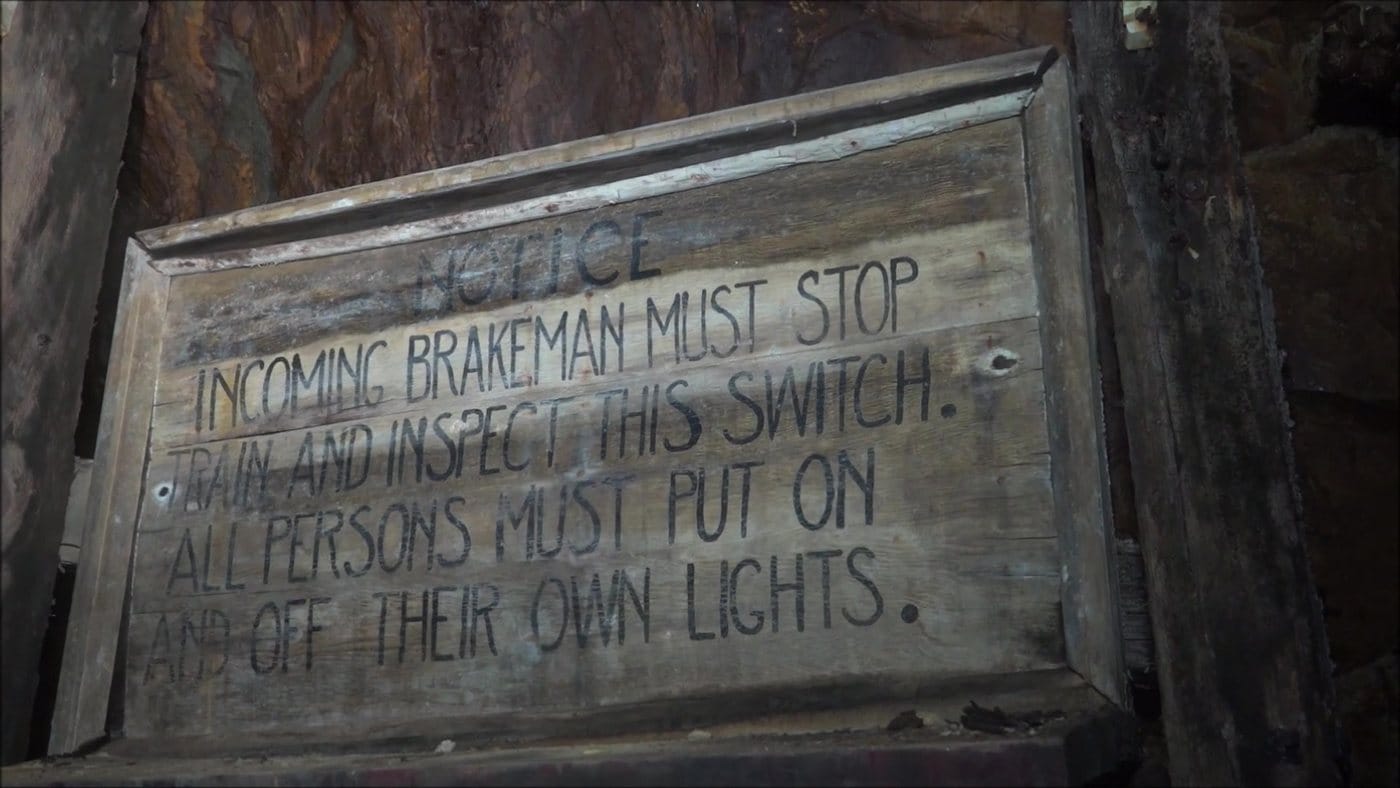
The province kept its own ledger. In 1916, the year the committee first met, its report lists five men killed in Granby’s mine at Anyox. In 1917, the year these articles were printed, two men died at Hidden Creek. On 9 February Mike Radeka, a miner, was killed by falling rock from the back of a stope. On 11 July P. A. Gustafson, a brakeman, was crushed between the end of a car and the side of a chute. That June, at the May-Beatrice, also listed at Anyox, a labourer named Nick Gullune died in a fall of rock. In 1918 four more men died at Hidden Creek.
At a junction underground, Frank’s light finds a board, its paint worn but legible. “Notice,” it reads. “Incoming brakeman must stop train and inspect this switch. All persons must put on and off their own lights.” No one can say whether it hung there in 1917. But it was written for a man doing P. A. Gustafson’s work.
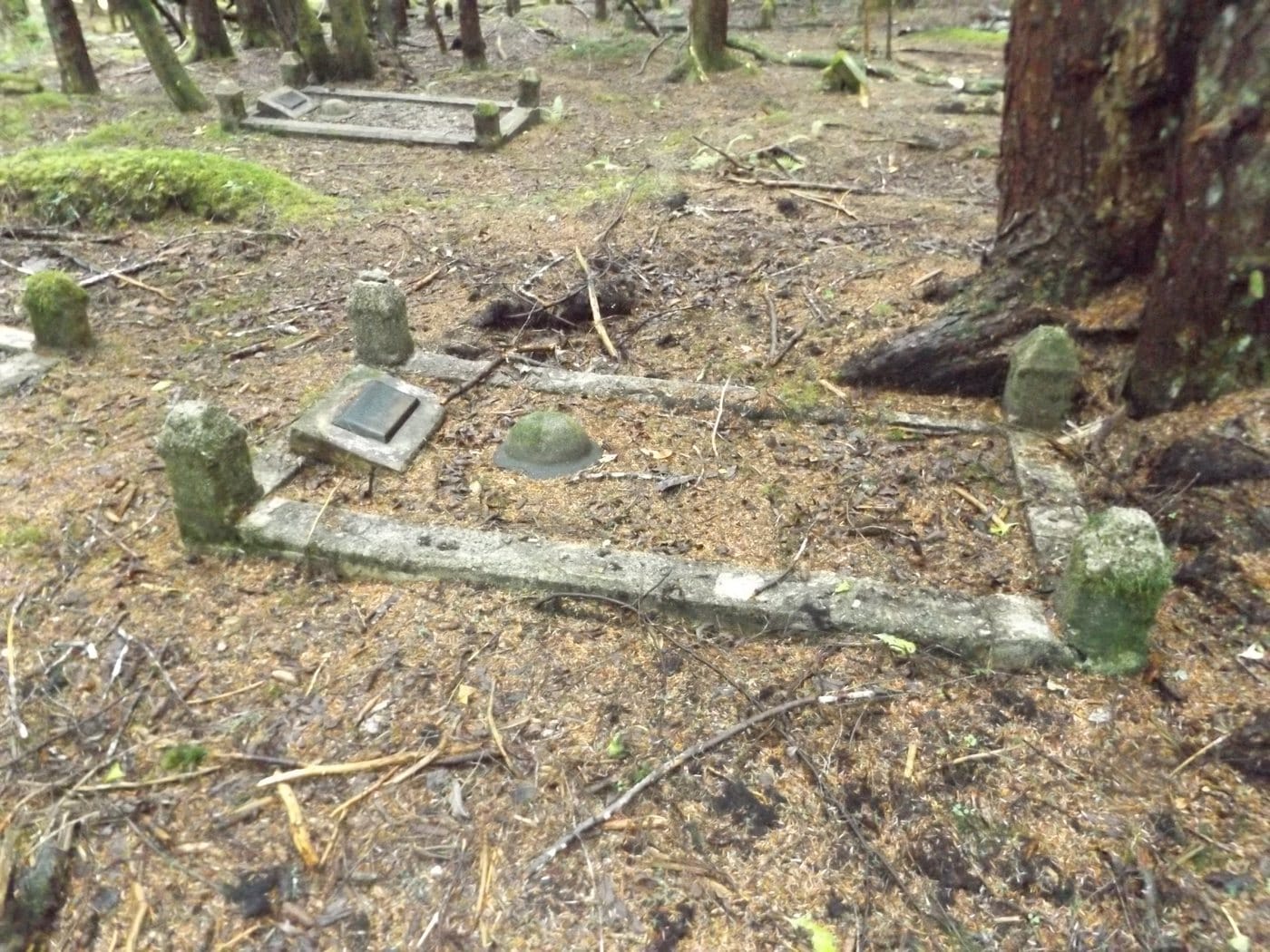
The reports give each man a name, a job and a cause, and nothing more. Each of them is on In Memory, the roll of the men who died in the province’s metal mines from 1906 to 1947, where each man is honoured with a brass tag. If one of them was your family, tell us about him.
Flying his drone through the ruined powerhouse, Frank once put his own work in a sentence: “You’re like a detective, you’re kind of trying to figure out how everything was set up and how it runs.” In 1917 the man who ran the smelters wrote down exactly that, how everything was set up and how it ran. He counted the lockers and the tons and the volts, and left the men who did the work unnamed. A century later Frank’s lens found what was left: the stack with daylight through its side, the hydrants in the forest, the brakeman’s notice in the dark. Neither record is whole alone. Together they give Anyox back.
The whole story, from the float John Flewin picked up on the shore in 1889 to the fire of 1942, is on the Anyox record.
More From the Journal
History & DiscoveriesOne Photograph