History & DiscoveriesThen and Now
A Name RememberedPeople & Places
The Journal →The Names Phoenix Kept
In 1920, as Phoenix was being taken apart, the town sold its skating rink to raise a granite stone carrying fifteen names. Who those men were, the boy who died as the rink came down, and the people who have kept the names ever since.
What is known
What the Phoenix Pioneer, the Greenwood Ledge and the Grand Forks Sun printed from 1900 to 1928, read on the page scans or, where the sources say so, in the papers’ full text; the war records of the fifteen men; Al Donnelly’s research on them for the Boundary Historical Society, with the photographs of the stone in his article; and Lois Haggen’s account of the town’s last days, given in 1957.
What is inferred
Who bought the rink: the papers of 1920 name only the Kelowna men taking it down for its lumber; Mrs. Haggen, thirty-seven years on, named a Vancouver firm; Al Donnelly, a scrap dealer. When the stone was formally unveiled, and who cut it. Which James Cochrane the stone remembers, and when Sidney Jennings died. Where the records disagree on a name, a date or an age, the text gives each.
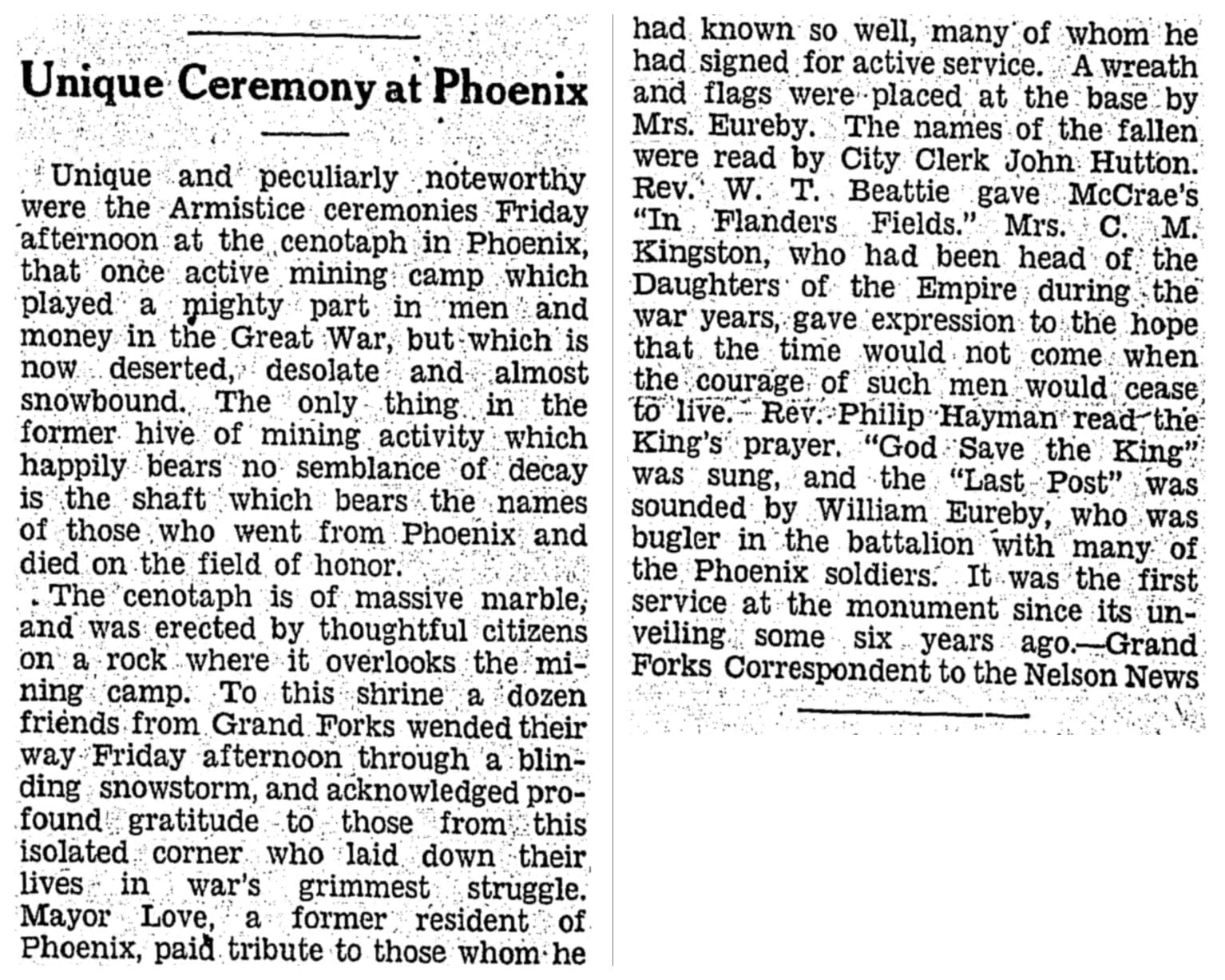
On Armistice Day in 1927, a dozen friends from Grand Forks made their way up through a blinding snowstorm to a town that was no longer there. The report of the day, written by the Grand Forks correspondent of the Nelson Daily News and reprinted in the Greenwood Ledge, called Phoenix “that once active mining camp which played a mighty part in men and money in the Great War, but which is now deserted, desolate and almost snowbound.” Everything else in the old camp was going to ruin. The one thing that “happily bears no semblance of decay,” the report said, was “the shaft which bears the names of those who went from Phoenix and died on the field of honor.”
City Clerk John Hutton read the names of the fallen, and William Eureby, who had been “bugler in the battalion with many of the Phoenix soldiers,” sounded the Last Post. It was, the report said, “the first service at the monument since its unveiling some six years ago.”
Seven years before that snowfall, in the last months of the town, Phoenix had given up its skating rink, where for twenty winters the town had skated and cheered its hockey team, and put what the rink fetched toward that stone. This is the story of the fifteen men whose names are cut in it, of the rink that paid for it, of a boy who died as the rink came down, and of the people who have kept the names since.
Twenty Winters on the Ice
In November 1900, the week the new City of Phoenix elected its first council, the Phoenix Pioneer told its readers the town would soon have a skating rink. William Drever had agreed to build one on the site of the tennis court: a building 70 by 170 feet around a sheet of ice 50 by 150, with a corridor all the way round and waiting rooms. “Work on the structure is to be started at once.” It opened on Christmas Day.
“They had a good curling and skating rink,” Lois Haggen said of those years, “and the men of that day seem to have been as keen on curling and hockey as they are now.” And Grand Forks was the rival: “Rivalry between Phoenix and Grand Forks was so keen that all the supporters had to go along and special trains of several cars each were run for the occasion.”
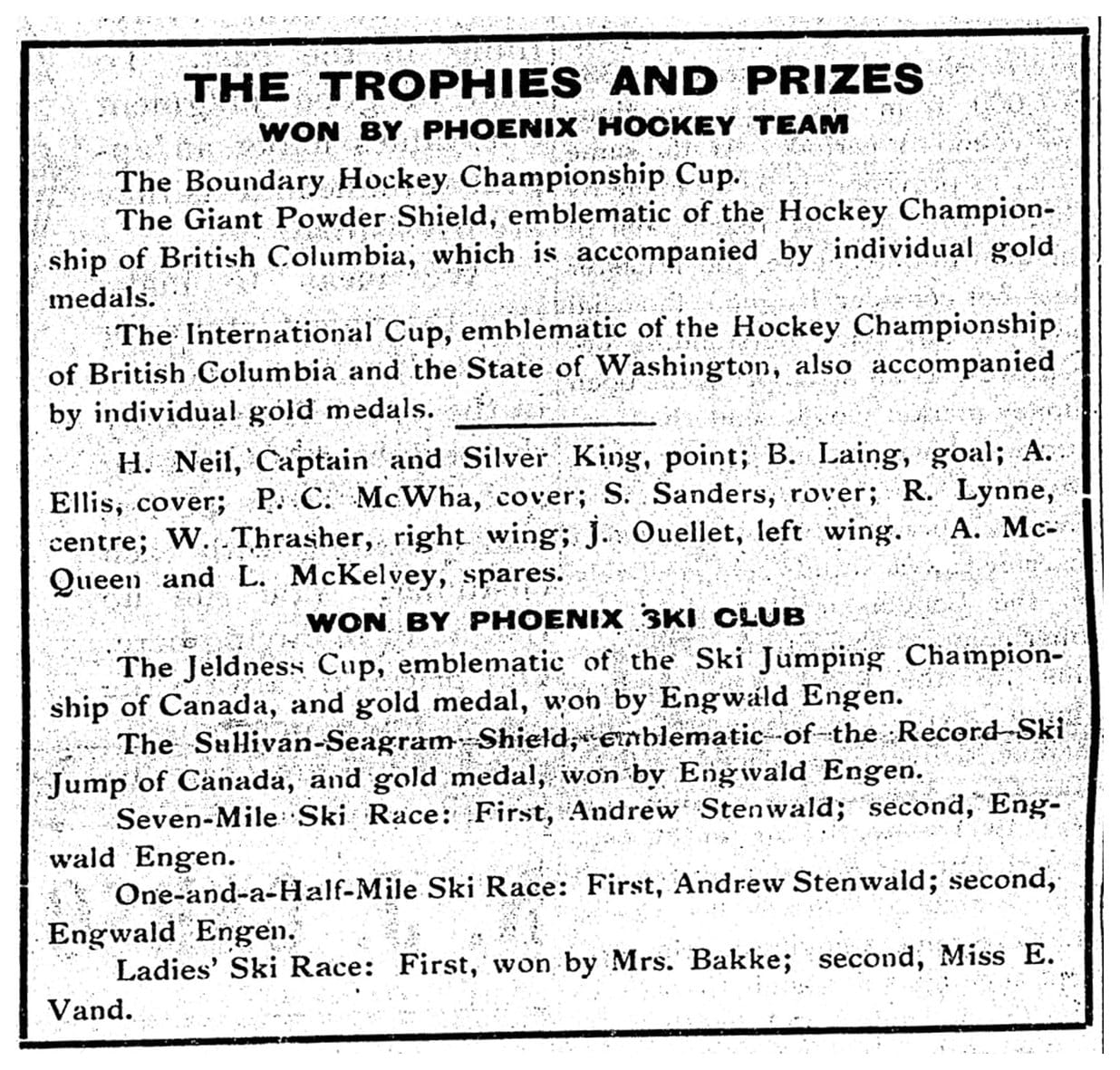
In February 1911 the hockey team and the ski club made what the Pioneer called a clean sweep at Rossland’s winter carnival, and the paper gave them its front page.

It listed the team’s silverware: the Boundary league’s championship cup, the Giant Powder Shield for the championship of British Columbia, and the International Cup, “emblematic of the Hockey Championship of British Columbia and the State of Washington.” The team had played eleven games that season without a defeat. The city met them with a banquet, a smoker and a dance.
The day before that front page, the club’s secretary, A. A. White, had wired the trustee of the Stanley Cup in Ottawa:
“Kindly consider this a challenge from Phoenix hockey team for the Stanley cup. Phoenix has won the Boundary hockey league championship cup, the British Columbia hockey championship shield, and the International cup, emblematic of the championship of British Columbia and the state of Washington. Former players in Stanley cup games have been playing in the Boundary league games and Phoenix will send challengers that must be reckoned with. What possible dates?”
A. A. White, secretary of the Phoenix Hockey Club, to William Foran, trustee of the Stanley Cup, 24 February 1911
Foran replied that three other challenges were before the trustees and no dates were left that season; he offered to arrange a series with the holders of the Cup at the opening of the next.
The rink itself was showing its age. In February 1912 the Pioneer led its front page with the news that the city council had decided to contribute toward the construction of “a combined skating and curling rink,” and could not resist a word about the old one: “The present structure, which has done such excellent service in providing winter amusement for Phoenicians could never be classed as ornamental, and has provoked a broadened smile on the face of many of our visitors.”

The rest came by public subscription. That autumn the old rink was bought out; a demolition gang took down the old curling rink and half of the skating rink, and the new building went up on the cleared ground. When the shareholders met in the Miners’ Union hall in December 1912, the chairman, J. E. Thompson, reminded them what it was for: they had helped keep Phoenix “well to the fore in the western hockey world.”
The new rink opened on the evening of New Year’s Day, 1913. The management had engaged Norval Baptie, “the famous skater,” for an exhibition. He did not come, and “his unavoidable non-appearance caused considerable disappointment,” so the committee put on a game between the Intermediates and the Seniors instead. The city band played for the skaters.
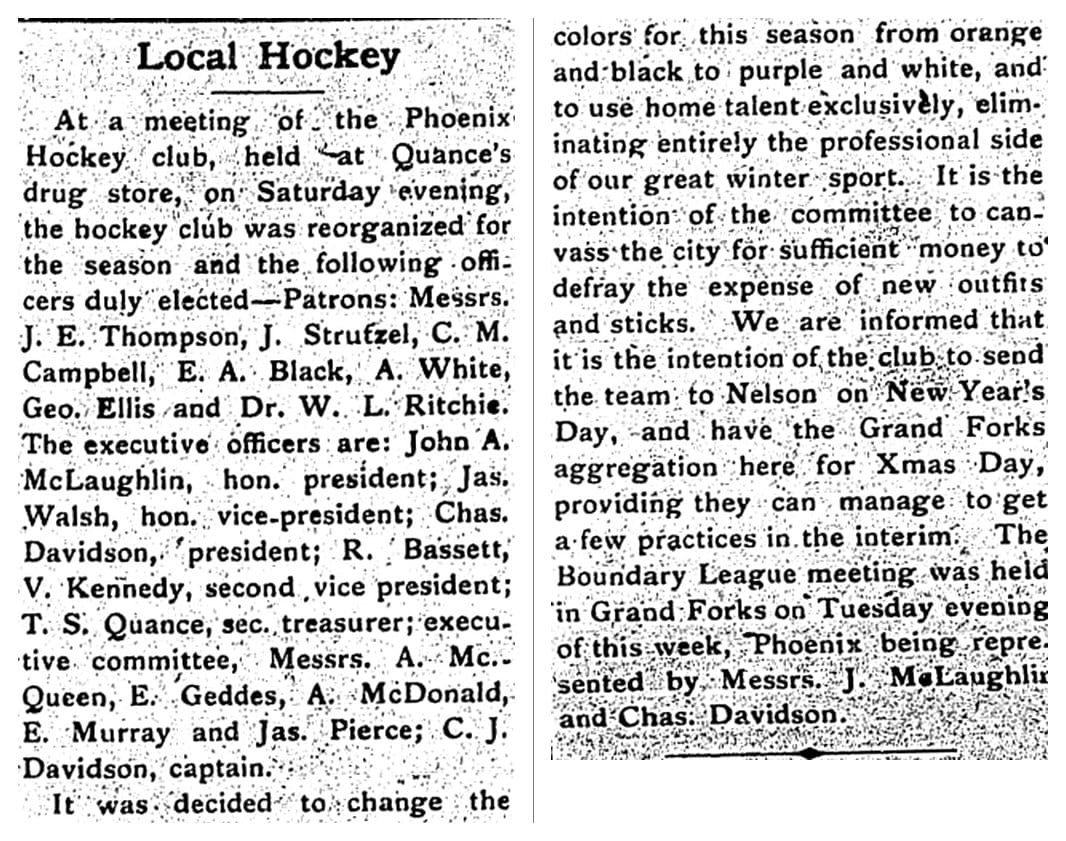
By December 1914 the war was four months old. At a meeting in Quance’s drug store, the hockey club reorganized for the winter. It changed its colours from orange and black to purple and white, and it resolved “to use home talent exclusively, eliminating entirely the professional side of our great winter sport.” The team would be the town’s own. On the executive committee sat an E. Geddes.
Saturday, 31 October 1914
Six weeks before that meeting, six men had left Phoenix together. “Phoenix is to be represented in General French’s army by another quota,” the Pioneer reported that Saturday, “and today, Saturday, a small detachment, consisting of Messrs. H. Sewell, John McQuoid, James Kempston, Sidney Jennings, James Pittpladdy and Harry Cameron, the latter of whom has enlisted for the automobile transport, will leave to join the two battalions now being assembled for training at Victoria.”
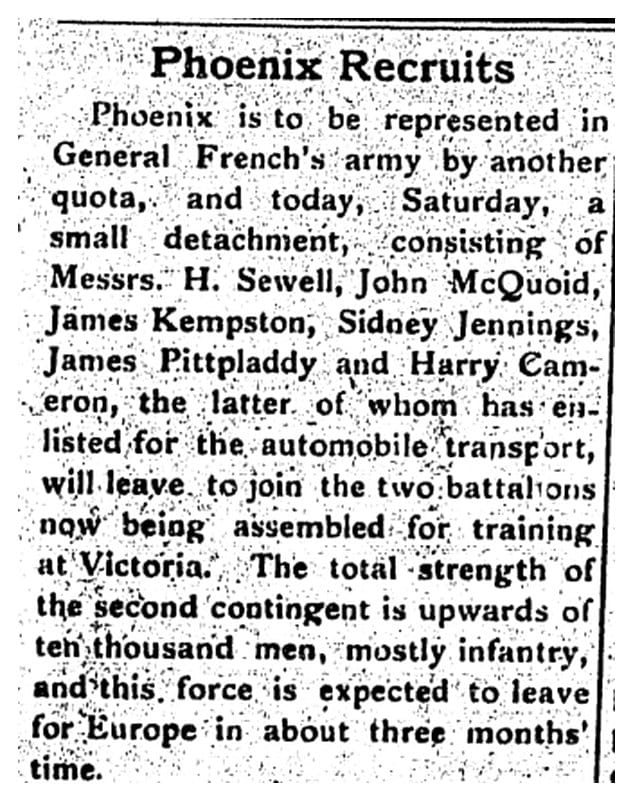
Three of the six are on the stone. At Victoria they were given numbers close together: Jennings 77724, Kempston 77726, Pitpladdy 77744. Another Phoenix man was already overseas: Thomas Monahan, a Granby brakeman, had gone with the first contingent. In all, Al Donnelly writes, perhaps as many as a hundred men from Phoenix and the camps around it enlisted, most of them Granby men. At home, what Phoenix raised for the war funds was, in Mrs. Haggen’s words four decades later, “almost unbelievable.”
News From the Trenches
The first death came in March 1915. Thomas Monahan was killed in France on the 3rd, and when the Pioneer reported him killed, in April, it still counted him among the town’s own: “formerly a brakeman at the Granby mine here in Phoenix.”
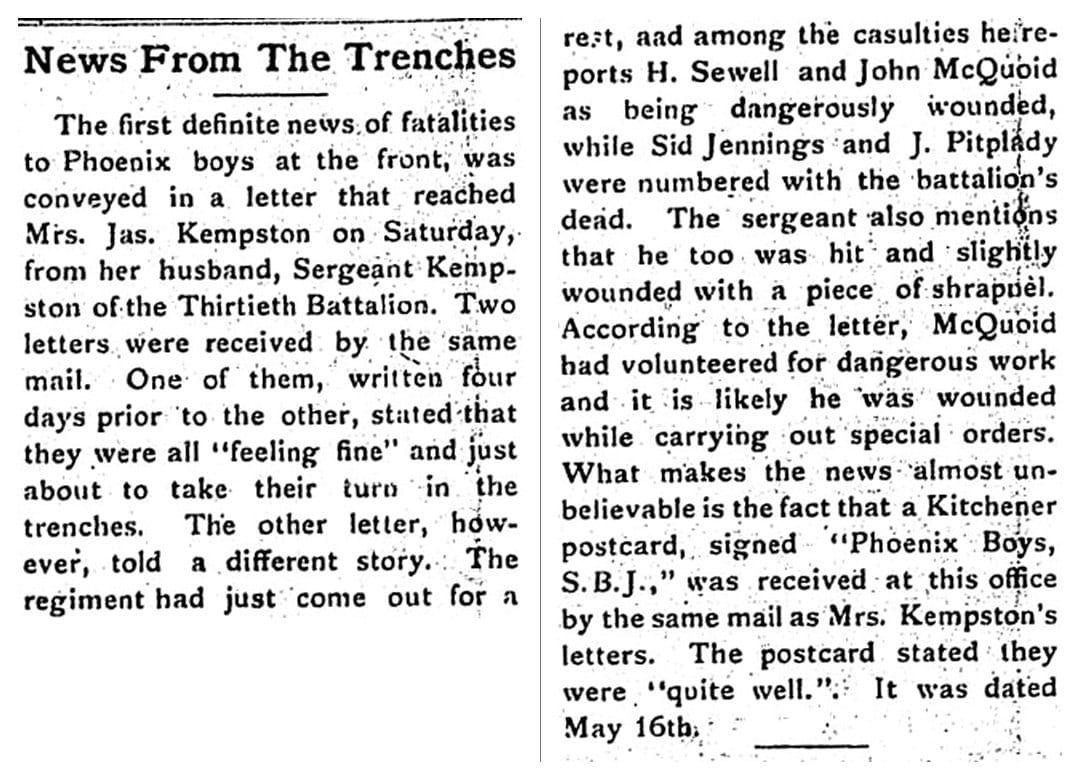
Then, in June, two letters from her husband reached Mrs. James Kempston by the same mail. The first, written four days before the other, said the Phoenix men were all “feeling fine” and about to take their turn in the trenches. “The other letter, however, told a different story.” The battalion had just come out of the line. H. Sewell and John McQuoid were dangerously wounded, “while Sid Jennings and J. Pitplady were numbered with the battalion’s dead.” Kempston himself had been hit by a piece of shrapnel, slightly. The Pioneer printed it on 19 June 1915 as “the first definite news of fatalities to Phoenix boys at the front.”
Something else had come by that mail. “What makes the news almost unbelievable,” the paper went on, “is the fact that a Kitchener postcard, signed ‘Phoenix Boys, S.B.J.,’ was received at this office by the same mail as Mrs. Kempston’s letters. The postcard stated they were ‘quite well.’ It was dated May 16th.”
S.B.J. were the initials of Sydney Bernard Jennings.
The Fifteen
The stone lists the fifteen by surname, from Cochrane to Wilkinson. Here they are in the order Phoenix lost them, each under his name as the stone has it. Most of what is known of their lives at Phoenix was gathered by Al Donnelly for the Boundary Historical Society, from the census of 1911, Granby’s own magazine and the war records.
Thomas Monahan
Born in Liverpool in 1888, Thomas Monahan worked for Granby as a mucker and a brakeman. He enlisted in September 1914 and went overseas with the first contingent. His war record places him in the 8th Battalion, from Winnipeg; the Pioneer, reporting his death, had him with Princess Patricia’s Canadian Light Infantry. He was killed on 3 March 1915, the first of the fifteen, and lies in Rue-David Military Cemetery at Fleurbaix, in France. He was 26.
Sidney Jennings
Sydney Bernard Jennings spelled his first name with two y’s; the stone has Sidney. He was born at Reading, in Berkshire, in 1890, and his parents’ home was at Caversham, close by. At Phoenix he was a grocery clerk at Morrin, Thompson and Company, which advertised itself in the Pioneer as the Big Store. He left with the detachment of 31 October 1914 and joined the 15th Battalion, the 48th Highlanders of Canada, at the front.
The official record gives his death as 24 April 1915 and lists him missing; he has no grave, and his name is on the Menin Gate at Ypres. The regiment’s own roll, though, shows him taken on the 15th’s strength only on 3 May, the same day as Kempston; the postcard signed with his initials was dated 16 May; and Kempston’s letter reported him dead together with Pitpladdy, who fell on 21 May. The dates cannot all be right, and no record yet found settles them.
James Pitpladdy
James Pitpladdy was a quarryman’s son from Furness, in Lancashire, and mined at Phoenix. His army papers give his birth as 15 July 1887, at Stainton, and Al Donnelly follows them; the census returns of 1901 and 1911 have him born at Urswick, close by, around 1890. He left with Jennings and Kempston in October 1914 and served beside them in the 15th Battalion. He was killed on 21 May 1915, in the fighting at Festubert, and has no known grave. His name is on the Canadian memorial at Vimy Ridge, and at home on the war memorial at the gate of Urswick church, spelled with two t’s, as the Pioneer spelled it on the day he left Phoenix. He was 27 by his papers; his family’s headstone says 25.
James Cochrane
James Cochrane worked for Granby as a blacksmith, and everyone in Phoenix remembered him for his music, always in demand at parties and special occasions. When the war began he went home to Scotland, Al Donnelly writes, enlisted in the British Army at Glasgow, was put to munitions work and died early in 1916; serving with the British, he left no Canadian record. There is one other candidate. Canada’s war records hold a Sapper James Cochran, spelled Cochrane by the war graves commission, number 503370, of the 2nd Tunnelling Company, a company of miners, who died on 2 June 1916, aged 38, and is named on the Menin Gate. The commission gives him a Liverpool family: he was the son of George and Mary Cochrane of Litherland and the husband of Catherine Cochrane of Liverpool. Donnelly’s James Cochrane was a Scot. Which James Cochrane Phoenix meant, the stone does not say.
D. M. Pittendrigh
David Morice Pittendrigh was born in Edinburgh in 1893 and worked at Phoenix as a clerk in the local branch of the Canadian Bank of Commerce. He enlisted at Victoria in March 1915, served in Belgium with the Canadian Pioneers of the 3rd Division, and died on 2 May 1916. He lies at Lijssenthoek, west of Ypres, where the casualty clearing stations were. He was 22.
James C. Kempston
James Campbell Kempston was born in Dublin in 1876 and had soldiered with the British Army in the Sudan and in South Africa. He came to Phoenix in 1910, where he was the city’s policeman and a cage tender for Granby. He left with the detachment of October 1914, at 38, a married man, and it was his letters to his wife that told Phoenix of Jennings and Pitpladdy. He came through 1915 with a shrapnel wound. On 3 June 1916, at Mount Sorrel near Ypres, he was posted missing and presumed dead. He has no grave; his name is on the Menin Gate. He was 40.
Fred Wilkinson
Frederick Samuel Wilkinson was born at Ulverston, in Furness, on 29 August 1897, by Al Donnelly’s account. He worked for Granby for a short time “as a lad in the glory hole,” Donnelly writes, and his father worked for the company too, at Phoenix and at Anyox, its copper camp on the north coast; the war records give his parents’ home as Anyox. Fred enlisted at Vernon in November 1915 and served in France with the Canadian Pioneers. He was killed on 6 April 1917, three days before the attack on Vimy Ridge, and lies in Ecoivres Military Cemetery, behind the lines. By Donnelly’s date he was 19, not yet twenty; the war graves record gives his age as 18.
Joseph Fleming
Joseph Fleming came from Kirkby-in-Furness, a slate village a few miles from Ulverston, where at fifteen he was an apprentice river, a splitter of slate, at the quarry. He served in the Manchester city police before he emigrated, shortly before the war, and at Phoenix he worked for Granby as a timberman. He enlisted at Victoria in February 1916 and served in France with the 54th, the Kootenay battalion. He was killed on the first morning of the attack on Vimy Ridge, 9 April 1917, and lies in Givenchy Road Canadian Cemetery, on the ridge itself. At home in Kirkby, his parents’ stone in the churchyard of St Cuthbert’s carries his name as well: “Also Joseph, eldest son of the above, Killed in Action at Vimy Ridge 9th April 1917, aged 32 years.” By the birth date on his papers, 28 September 1885, he was 31; the war graves record gives his age as 33.
Roy A. MacDonald
Roy Angus McDonald spelled his name Mc, not Mac as the stone has it. He was born in 1896 at Peter’s Road, on Prince Edward Island, and worked for Granby as a carpenter’s helper. He joined up at Grand Forks early in 1916, trained at Vernon and in England, and served in France with the 54th. He and Joseph Fleming were in the same battalion on that first morning at Vimy, and neither came back. Roy lies in La Chaudière Military Cemetery, near the village of Vimy. He was 20 by the birth date Donnelly gives, 9 August 1896; the war graves record gives 21.
John Lindsay
John Lindsay was born at Shotts, in Lanarkshire, in 1885, one of four brothers who went to the war. He was a clerk at Morrin, Thompson and Company, Donnelly writes, and the Ledge remembered him from Rendell’s store in Greenwood. He enlisted at Vernon in August 1916 and served with the 3rd Field Ambulance of the Canadian Army Medical Corps. He died on 6 November 1917, the day the Canadians took Passchendaele, and lies in Oxford Road Cemetery near Ypres. He was 32.
John A. Parry
John Armfield Parry, the son of Peter and Mary Parry of Dyserth, in North Wales, worked for Granby as a mucker at the Gold Drop mine. He enlisted at Kamloops in 1916, in January by Al Donnelly’s account and on 31 July by his war record, and served in France with the 47th Battalion. He came through Passchendaele and was a lance corporal when he died, on 29 April 1918. He lies in Aubigny Communal Cemetery Extension, in France. He was 26.
Dudley MacMillan
The stone says Dudley MacMillan, and Dudley is the name the Greenwood Ledge gave in October 1918, when it reported him killed at the front: “He was a former resident of Phoenix and Greenwood.” Al Donnelly found him in the war records as Duncan Daniel McMillan, born in Glengarry County, Ontario, on 13 January 1889, a cook at Deane’s Hotel in Phoenix. He enlisted at Vernon in May 1915 with the 54th, served later with the 2nd Canadian Mounted Rifles, and was killed in action on 5 July 1918. He lies in Wailly Orchard Cemetery, near Arras. Whether Dudley was a nickname or a slip, the town used it, and the stone keeps it. He was 29.
Anton Johnson
Anton Johnson was born at Växjö, in Sweden, in 1887 and mined for Granby; his brother Axel worked at Phoenix too. He enlisted at Victoria in June 1918, in the last summer of the war, and was posted to the Canadian Railway Troops. He died at sea on 11 October 1918, on the way to England, Donnelly writes, without reaching the front, and he is buried at Plymouth, in Efford Cemetery. He was 31.
Oscar Gustafson
Oscar Gustafson was born at Örebro, in Sweden, in 1885, came to Canada in 1911 and worked for Granby for years as a trackman and a miner. He enlisted at Victoria in April 1918 and served in France with the 31st Battalion. He died on 14 October 1918, four weeks before the Armistice, and lies in Bucquoy Road Cemetery, south of Arras. He was 33. The two Swedes on the stone died three days apart.
Elmo R. Geddes
Elmo Raymond Geddes was born in Winnipeg in 1895. At Phoenix he loaded ore for Granby and worked as a blacksmith’s helper in the machine shop. Donnelly credits him with helping bring the interior championship of British Columbia to Phoenix, and an E. Geddes sat on the hockey club’s committee in December 1914, the winter it chose to play its own. In February 1916 the Pioneer reported an Arthur Geddes, the hockey player, joining up with Roy McDonald; whether that was Elmo under another name or a brother, the papers do not say.
Elmo enlisted at Phoenix on 28 April 1916; his war record names his wife, Eleanor. He won the Military Medal. In September 1918 he was wounded and lost his left leg, and he was brought home by way of England to Canada. He died of his wounds at Lethbridge, near his parents’ home at Coaldale, on 21 June 1920, and lies in the I.O.D.E. plot of the Mountain View Cemetery there. He was 24, the last of the fifteen to die. When the stone went up four months later, his name was on it.
His son, Frederick Elmo Geddes, died in the next war, on 18 March 1945, serving in the Royal Canadian Navy aboard HMCS Guysborough.
The Rink Comes Down
Granby closed its Phoenix mines in 1919. The ore was running low, the war had made men and materials hard to get, and the end, when it came, was quick. “So quick was the exodus,” Mrs. Haggen said, “that many left, not only their homes but the furnishings in them.”
Plans for a memorial had been drawn up when the war ended, Al Donnelly writes, but they were not settled before the mines closed. The rink opened for one more winter, in December 1919. By August 1920 it had been sold. “The Skating rink in Phoenix has been sold and is being torn down,” the Ledge reported on 19 August. “It is stated that the proceeds of the sale will go towards building a monument in that town, in memory of the local boys who gave their lives and those who saw service in the Great War.”
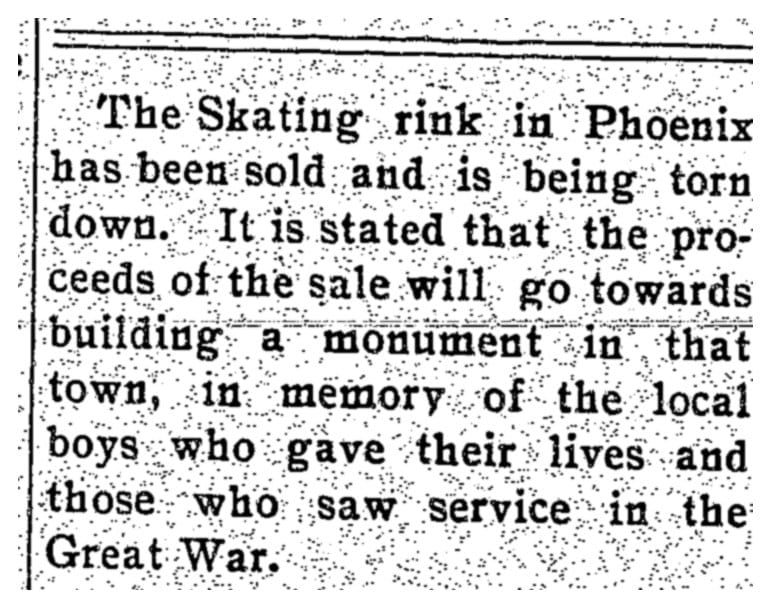
Who sold it, and to whom, the papers of 1920 do not say; they name only the three Kelowna men who were taking the building down for its lumber. The rink belonged to the Phoenix Rink Company, and the city itself was among its shareholders. Lois Haggen, speaking in 1957, said that the city council, as it wound up the city’s affairs, “sold the skating rink, which had been paid for by public subscription, to a Vancouver firm,” used what it fetched to build the cenotaph, and provided for the stone’s care through the Legion in Grand Forks. Al Donnelly has the rink’s owners selling it to a scrap dealer. Mrs. Haggen spoke thirty-seven years after the fact, and the Canadian Legion she named was founded only in the mid-1920s. On what matters, every account agrees: the town gave up its rink to raise the stone.
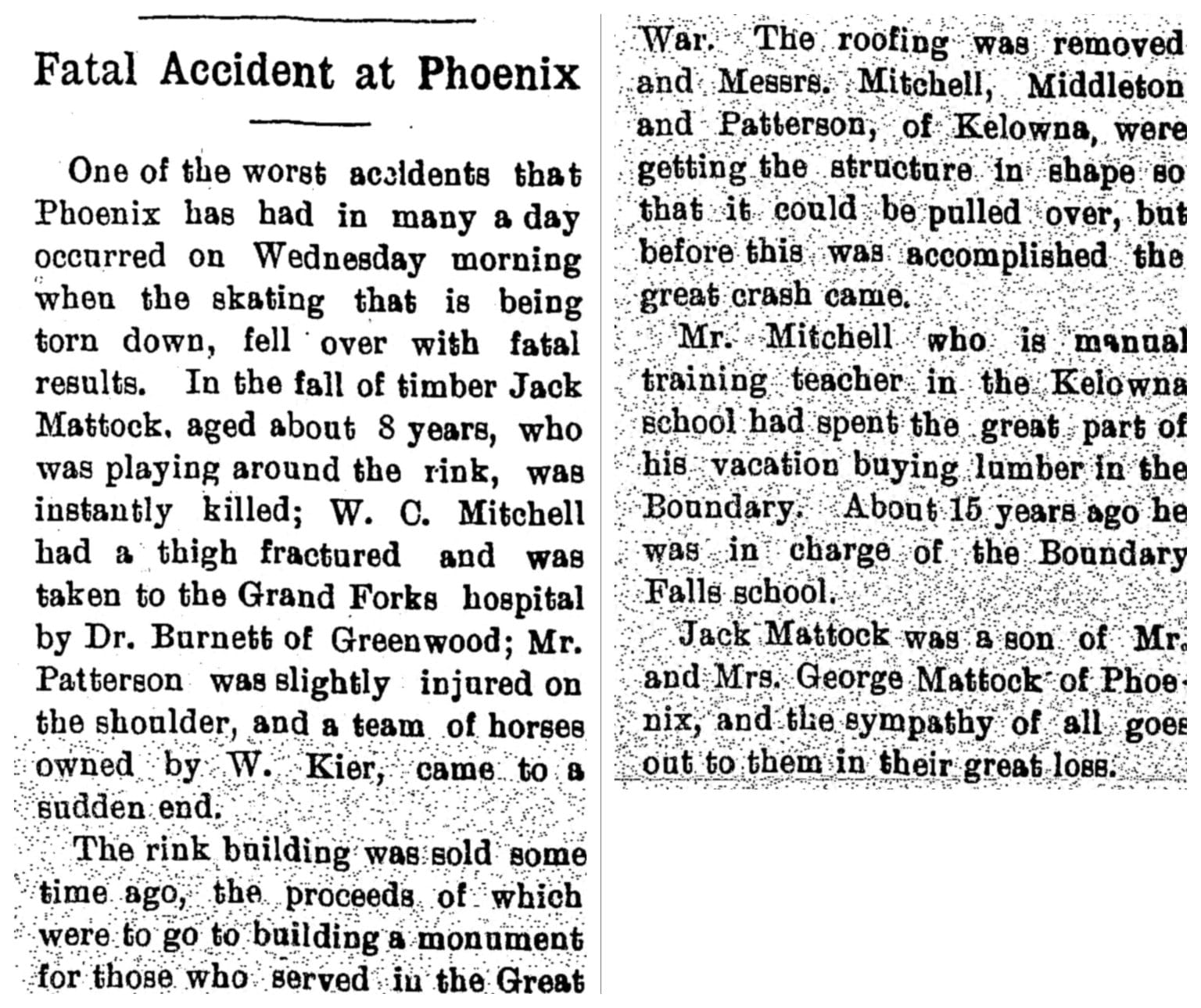
On the morning of Wednesday, 1 September 1920, the partly dismantled building fell over. The roofing had been stripped, and the three Kelowna men, Mitchell, Middleton and Patterson, were getting the frame ready to be pulled over, “but before this was accomplished the great crash came.” A boy who was playing near the rink was killed: Jack Mattock, about eight years old, the son of Mr. and Mrs. George Mattock of Phoenix. W. C. Mitchell’s thigh was broken, Mr. Patterson’s shoulder was hurt, and a team of horses belonging to W. Kier was killed. Mitchell, the Ledge added, taught manual training in the Kelowna school and had spent most of his vacation buying lumber in the Boundary; some fifteen years before, he had been in charge of the school at Boundary Falls.
The Grand Forks Sun called the boy John. “The remains of the unfortunate Mattock boy were brought here for burial,” it reported, “and they were interred in Evergreen cemetery yesterday”: Thursday, 2 September 1920, at Grand Forks. “The sympathy of all,” the Ledge wrote, “goes out to them in their great loss.”
His name is not on the stone, which was raised for the men of the war. He belongs in its story all the same.
Fifteen Names in Grey Granite
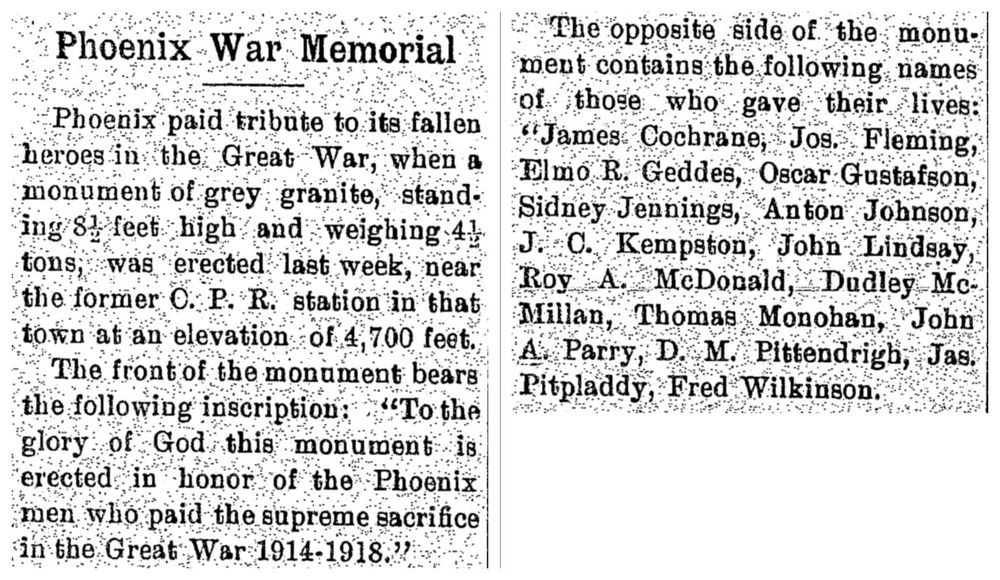
Seven weeks later the stone was up. “Phoenix paid tribute to its fallen heroes in the Great War,” the Ledge reported on 28 October 1920, “when a monument of grey granite, standing 8½ feet high and weighing 4½ tons, was erected last week, near the former C. P. R. station in that town at an elevation of 4,700 feet.”
Its face bears the line from Horace that so many memorials of that war carried, dulce et decorum est pro patria mori, and beneath it the town’s dedication. The fifteen names are on the other side.
On Its Face
- To the
- Glory of God
- this
- Memorial
- was erected
- in honor of
- Phœnix Men
- who paid the
- supreme sacrifice
- in the
- Great War
- 1914–1918
On the Other Side
- James Cochrane
- Joseph Fleming
- Elmo R. Geddes
- Oscar Gustafson
- Sidney Jennings
- Anton Johnson
- James C. Kempston
- John Lindsay
- Roy A. MacDonald
- Dudley MacMillan
- Thomas Monahan
- John A. Parry
- D. M. Pittendrigh
- James Pitpladdy
- Fred Wilkinson
As cut in the stone, from the photographs of both faces in Al Donnelly’s article. Above the dedication is a line of Latin.
Charles M. Campbell, who had worked at Phoenix for Granby as a mining engineer and surveyor, wrote, in an article Al Donnelly dates to about that time:
“A modest granite shaft now stands, at an elevation of 4,700 feet, on an outcrop of rock, beside the highest point on the roadway over the divide between Greenwood and Grand Forks. This is the only stone structure ever erected in Phoenix, and long after all the buildings have rotted away, the waste dumps and glory holes have been hidden by a new forest growth, and the deer have returned to their former haunts, this shaft will remain as a memorial not only to the men who gave up their lives in Flanders, but also to the place they came from.”
Charles M. Campbell, as quoted by Al Donnelly for the Boundary Historical Society
None of the papers of 1920 read for this piece names the firm that cut the stone; the national inventory of military memorials credits Patterson, Chandler and Stephen, of Vancouver. When it was formally unveiled is not recorded in any paper found. The 1927 report’s “some six years ago” would make it 1921.
The Town That Was Left
In 1921 the Legislature passed the Phoenix Disincorporation Act, and the City of Phoenix ceased to be. Before it went, the council saw to its caretaker. Mrs. Haggen called him Adolph Cirque, “always known as ‘Forepaw’”; the Phoenix cemetery list has him as Adolph Sercu, “generally known by the nickname ‘Forepaw.’” An infection had cost him his hand and lower arm, and he had gone back to work with a crude iron hook the blacksmith made him. The council kept him on to look after things for about a year while the last residents got out. “They made a silver star from a tomato tin,” Mrs. Haggen said, “gave this and a ‘billy’ to Forepaw and said, ‘Now you’re the boss.’” Forepaw moved into the city hall and called himself mayor as well as constable.
Late in 1921 the Ledge could report that Phoenix had a single inhabitant: “the Mayor, policeman and the whole show.”
Keeping the Names
The stone stood in an empty town, and people came back to it. At the snowstorm service of 1927, Mayor Love, “a former resident of Phoenix, paid tribute to those whom he had known so well, many of whom he had signed for active service.” Mrs. Eureby laid a wreath and flags at its base. The Rev. W. T. Beattie gave McCrae’s “In Flanders Fields.” Mrs. C. M. Kingston, who had led the Daughters of the Empire through the war, spoke of her hope “that the time would not come when the courage of such men would cease to live.”
A year later, eight automobile loads of veterans and citizens went up to “the lonely Phoenix cenotaph,” decorated it with wreaths, and heard Dr. C. M. Kingston, the member of the Legislature, speak there.
Phoenix sits high, and on the eleventh of November it often could not be reached. So the names went down the valley as well: a bronze plaque bearing the same fifteen was mounted on the cenotaph at Kettle Valley, by Rock Creek.
In the 1950s Granby came back, to mine the old town’s ground from the surface as an open pit. Before the blasting began, the company’s superintendent, Harvey Parliament, had the stone moved some 1,500 feet, out of harm’s way. When Mrs. Haggen gave her address on Phoenix to the British Columbia Historical Association in Victoria on 8 March 1957, the meeting voted to send him a letter of commendation “for the moving of the cenotaph to its new location.”
Al Donnelly kept the names in his own way: for the Boundary Historical Society, he went looking for the men behind them and wrote down who they were.
It stands there still, beside Phoenix Road, and people still gather at it in November. In 2017 nearly two dozen came, some of them from Kelowna and Penticton. They recited “In Flanders Fields,” kept a moment of silence at eleven, read aloud the names on the stone, and then, around a fire, shared stories of their families’ part in the two world wars and in other military operations.
Charles Campbell was right. The buildings rotted away, the pit took the ground the town had stood on, and the forest came back, and the deer. The stone remains, a memorial to fifteen men and to the place they came from. When Phoenix knew it was finished, the last thing it raised was for them.
Fifteen names are cut in that granite. Remember one more with them: Jack Mattock, about eight years old, who was playing near the rink on the morning it fell.
If one of these men was your family, tell us about him. The camp they came from is on the Phoenix record.
More From the Journal
Out With FrankThe People Behind the Mine