
Hardy Mountain Camp · Boundary Country
Yankee Boy
Shipped ore 1899–1942
Three gold claims near Grand Forks that sent an early carload out of the Boundary by rail in 1899, kept coming back until 1942, and came back once more in 2021.
The record →
One PhotographHistory & Discoveries
The Journal →In September 1906 a trade journal reported that Granby had taken its steam shovel out of the open cut at Phoenix: mining from the level below had undermined the ore beneath its tracks. The story of a machine that ran out of ground.
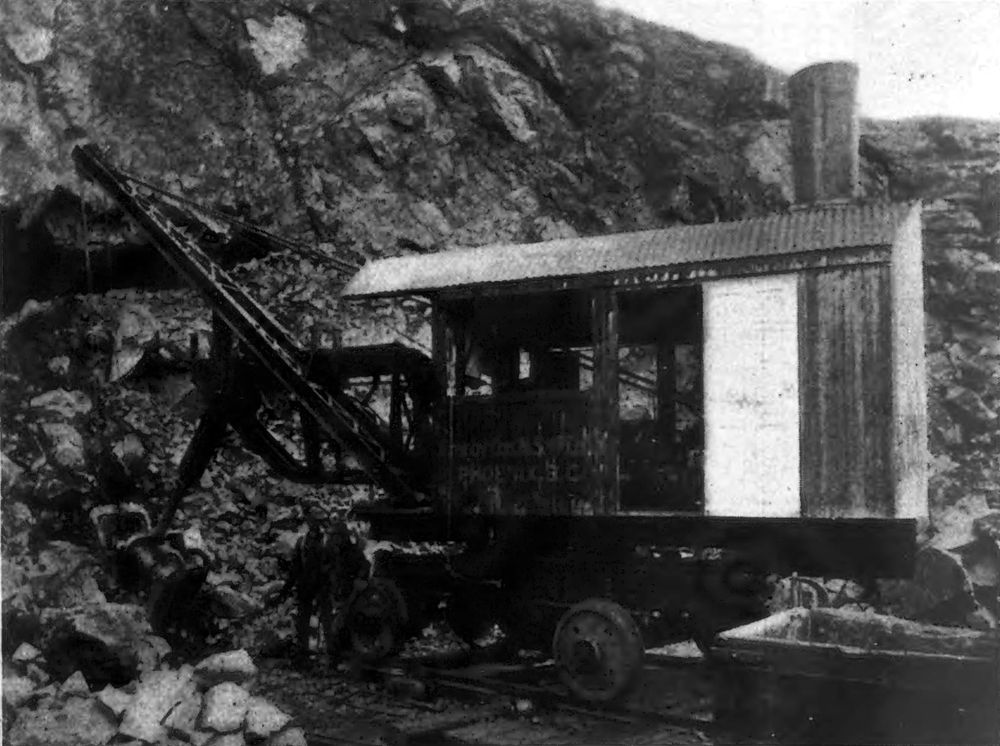
In June 1903, the Engineering and Mining Journal reported that the Granby company had recently installed a steam shovel for Knob Hill ore.
In September 1906, it reported the open-cut shovel withdrawn, the ore beneath its tracks undermined from the level below, and printed the photograph that opens this story.
Early in 1914, Granby bought a Bucyrus 40-R electric shovel. Its superintendent described the work in the same journal in December 1916.
Who took the photographs, or on what day.
The exact date the steam shovel was withdrawn, and which of the mine’s two steam shovels it was.
Whether any shovel worked at Phoenix between the provincial report of 1907 and the purchase of 1914: the sources do not establish continuous shovel use. No account describes an accident to any of these machines.
The shovel takes up much of the photograph: a timber-sided cab, a tall stack, a boom reaching into broken rock. It looks substantial. The man standing beside it gives it scale; the article beneath it gives the size of its dipper: three quarters of a yard. What the picture cannot show is the ground beneath its rails.
In September 1906, the Engineering and Mining Journal reported that the steam shovel had recently been taken out of the open cut at Phoenix. Mining from the level below had undermined the ore on which its tracks rested. The mine was changing the ground the machine stood on.
The machine had not been there long. In June 1903 the same journal's Victoria correspondent had reported that "The Granby Company has recently installed a steam shovel for handling Knob Hill ore," which squares with the 1906 account that the shovel had worked the cut "for about three years."
The 1906 report is an admiring one, written at a camp treating 2,700 tons of ore a day, and it treats the withdrawal as what it was: a note about ground, not an accident. The portion of the orebody carrying the shovel's tracks had been mined from beneath, and the machine was taken out. No exact date is given, and nothing dramatic is claimed.
Phoenix's cuts were never ordinary quarries. The same article's photographs of the "semi-open cuts" show surface workings opening straight into timbered stopes (the spaces left where ore has been mined out), and its closing lines describe the open cut "exposing the old stopes and workings of several years ago." Surface and underground were taking the same orebody, and in 1906 the underground got to that block first.
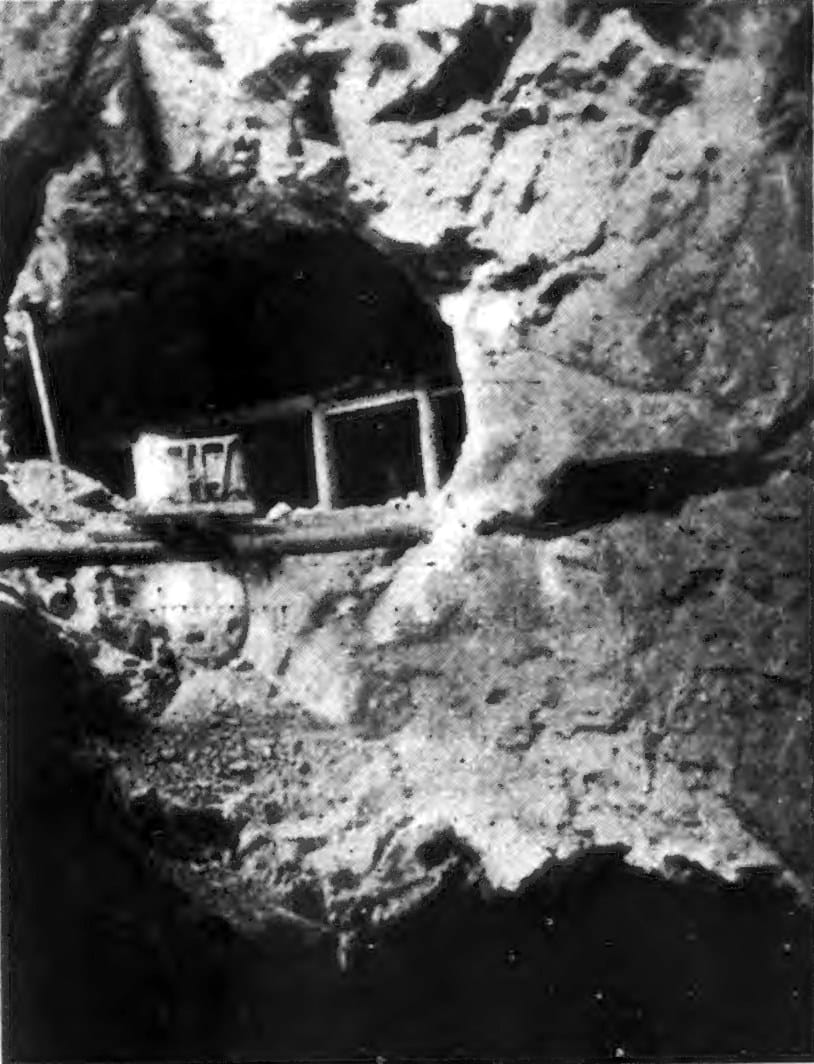
By 1907 the province's Gold Commissioner recorded the sequel: at the No. 1 level, "where formerly two steam shovels were at work," there was nothing but stoping, "it being more economical to break and drop the ore in chutes to the lower levels." The simplest way to move broken ore, sometimes, was to let it fall.
The shovel's return came as a decision, from inside the company. Early in 1914 Granby bought a Bucyrus 40-R electric shovel for the No. 2 tunnel level (the same level whose ore trains appear in the 1906 photographs), and in December 1916 the superintendent, C. M. Campbell, explained why in the same journal.
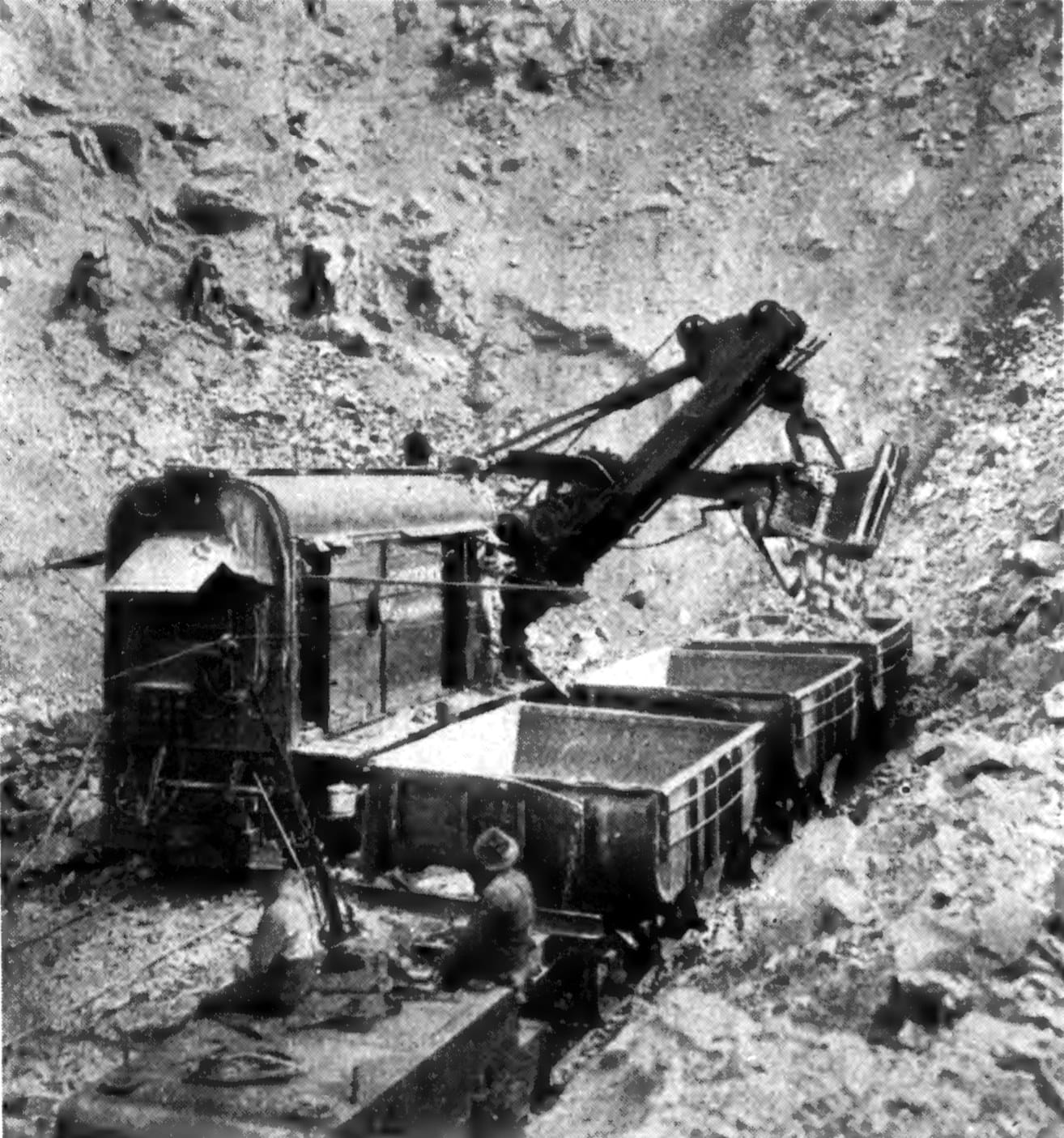
Waste, about half of everything moved, could be loaded in large masses direct. Ground ahead of the shovel that had already been mined underground was caved deliberately and the broken rock drilled with small drills.
The pit was widened until the shovel had two working positions on diverging tracks, and Campbell gives the reason plainly: it is safer, because the miners can be drilling and barring down (clearing loose rock) in one part of the pit while the shovel works in the other.
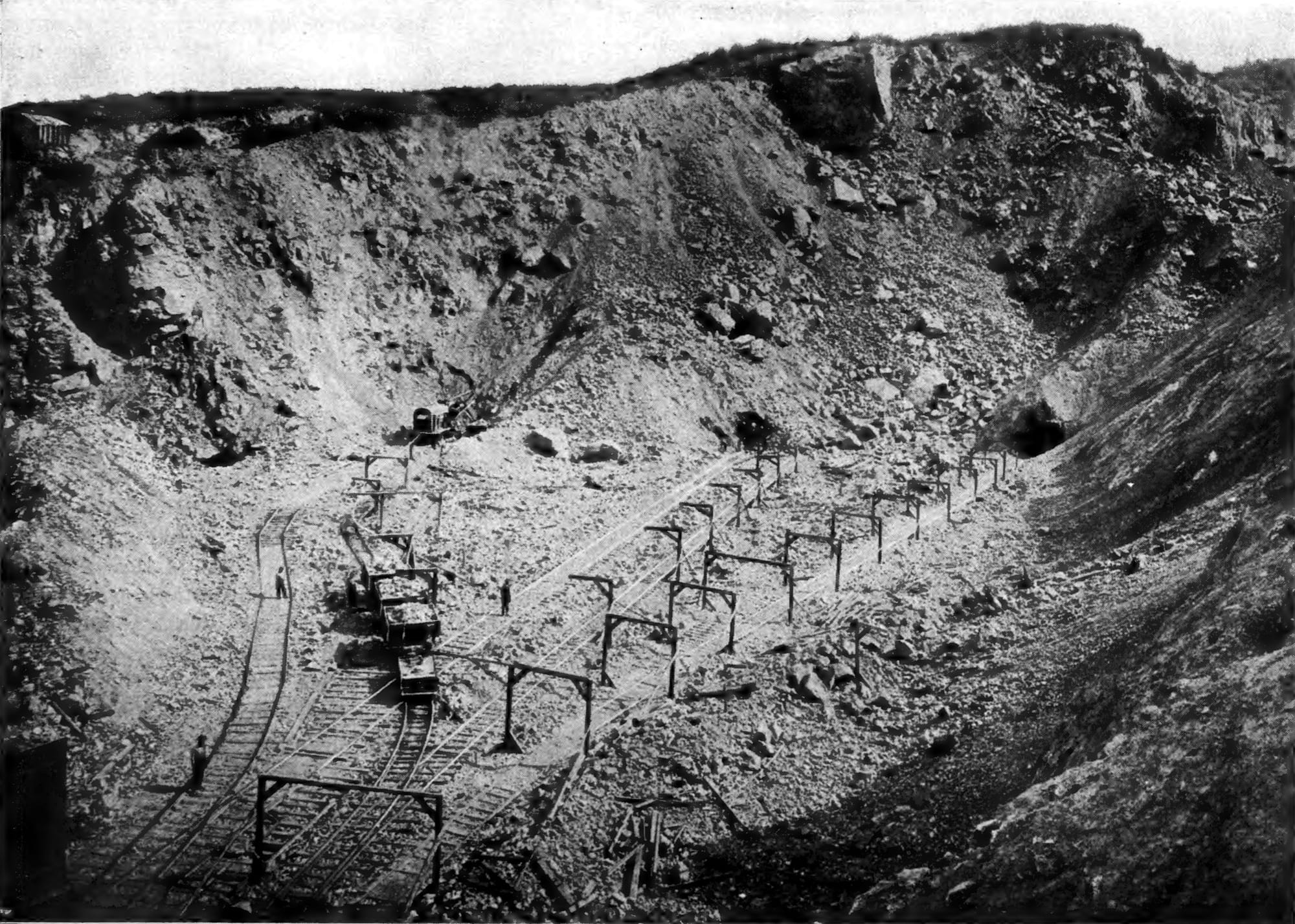
His photograph shows the machine loading side-dump cars, with figures at work on the slope above; the pit view published with it shows the two tracks parting among the trolley poles. By his reported figures, the shovel had handled about 500,000 tons at about 45 cents a ton, losing only 3½ per cent of its time to repairs.
In 1906 the underground took the ground out from under a steam shovel. From 1914 the company worked that same condition on purpose: cave the mined ground, break it small, keep the men and the machine apart.
The glory holes, the closing of 1919 and the open pit that returned in 1959 are told in the Phoenix record. This is the smaller lesson the two photographs hold between them: at Phoenix, what mattered was not only what the shovel could lift, but what remained beneath the place where it stood.
A separate event from these years, the fall of rock of 5 July 1914 that killed J. F. McDougall, William Tatham and Frank Riordan, is kept with the men of Phoenix in our In Memory record; the sources here do not connect it to the shovel work this story describes.
Checked against the original pages on November 15, 2026. Photographs reproduced from the original issues; photographers unidentified; image dates are publication dates.
The Mine Record
Every British Columbia mine Frank has filmed gets a record: the province’s own numbers, the names it went by, the years it worked, the story, and the film. All the mines →
Hardy Mountain Camp · Boundary Country
Shipped ore 1899–1942
Three gold claims near Grand Forks that sent an early carload out of the Boundary by rail in 1899, kept coming back until 1942, and came back once more in 2021.
The record →

Franklin Camp · Boundary Country
Shipped ore 1913–1947
Four prospectors with no capital shipped rich ore from the glory hole in 1913. Then Hecla’s mill made the Union one of the province’s biggest gold mines, 1930 to 1932, and the richest car of 1931 went out raw.
The record →

Anyox Camp · North Coast
Worked 1914–1935
A copper company's town on the north coast: 2,500 people, a smelter and a mine, shut down in 1935 and burned in 1942.
The record →
News & Heritage
History & DiscoveriesA Closer Look
Never go into an abandoned mine. The films are the way in.
Come Along with Frank
He’s retired, so there’s no schedule. But he’s always out there, and he always has that camera.