
Hardy Mountain Camp · Boundary Country
Yankee Boy
Shipped ore 1899–1942
Three gold claims near Grand Forks that sent an early carload out of the Boundary by rail in 1899, kept coming back until 1942, and came back once more in 2021.
The record →
News & Heritage
The Journal →What is underway in the hills above Greenwood in late 2026 is mineral exploration: diamond rigs pulling up narrow cylinders of rock so geologists can log the stone and send it out for assay.
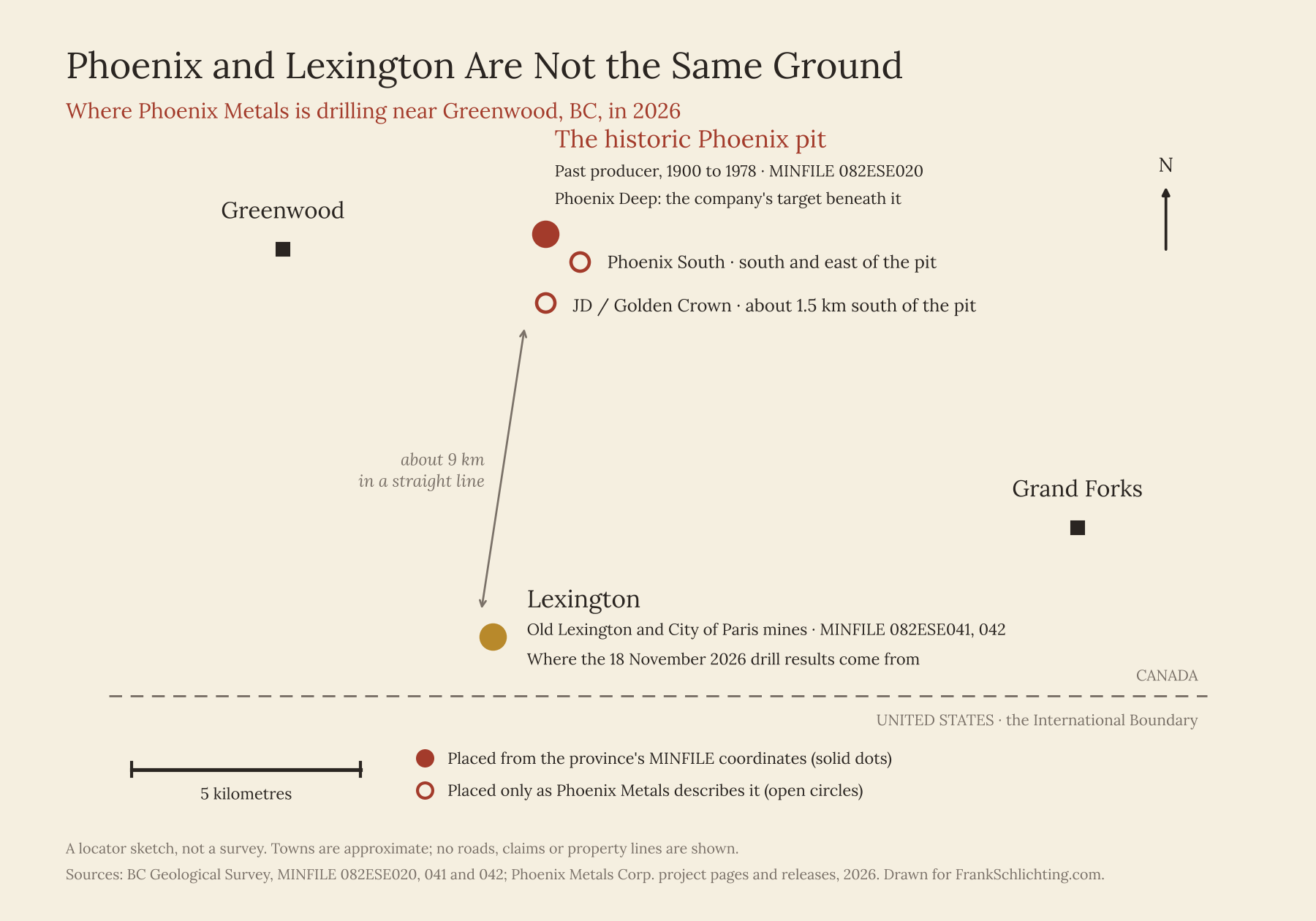
Drill rigs are turning again beside the historic Phoenix pit near Greenwood, BC, though the first assay results of 2026, released on November 18, actually came from a separate site nine kilometres south toward the US border. Here is where the drills are working, what the permits actually cover, and what it would take before anyone could call Phoenix a working mine again.
Published November 19, 2026 · Next update: Phoenix Metals expects its first Phoenix South assay results in December 2026.
Spend any time around the Boundary Country when core boxes start stacking up and the question inevitably comes up over coffee: Is the old Phoenix mine reopening?
Right now, the answer is no. What is underway in the hills above Greenwood in late 2026 is mineral exploration: diamond rigs pulling up narrow cylinders of rock so geologists can log the stone and send it out for assay. Turning a drill bit to test what the old-timers left behind is how every new mine starts, of course, but a drill program is not a mine reopening, and an exploration permit is a long way from a production approval.
The company behind the work is Phoenix Metals Corp. of Vancouver, which went public on the Toronto Stock Exchange this past July after consolidating more than 12,000 hectares of claims, leases, and old Crown grants between Greenwood and Grand Forks.
It is easy to see why the company borrowed the Phoenix name. For the better part of the twentieth century, Phoenix was the heavyweight of the Boundary camp. Granby Consolidated worked the deposit underground from 1900 until 1919, then returned in 1959 with power shovels to carve out a sprawling open pit that swallowed nearly all of the turn-of-the-century stopes and drifts. By the time the mill finally shut down in the autumn of 1978, Phoenix had yielded roughly 21.5 million tonnes of copper-gold-silver ore. (You can read the full history and watch the underground footage on the Phoenix record.)
Follow the numbers
Phoenix Metals went public on the Toronto Stock Exchange in July 2026 at $1.25 a share, under the symbol PCA. Here is where its shares stand now, beside the three metals its drills are after.
The share price and the metal prices fill in on this story’s own page: see the numbers as they stand. Shown for reference: this is reporting, not investment advice.
Because Phoenix Metals uses the Phoenix name for the company itself while bundling half a dozen historic camps into its Greenwood project, headlines can easily blur together. Sorting out five key names makes the 2026 news much easier to follow:
Reading the company’s autumn filings in order shows how quickly the drilling expanded once the late-summer paperwork cleared:
If you saw the November 18 headlines touting copper, gold, and silver intercepts, every metre of that rock came from the ground at Lexington, nine kilometres south of Phoenix. The release covers the first nine holes (3,063 metres of core) from Lexington, while another eleven holes from that camp are still waiting on the assay lab. (In keeping with this site’s policy, we leave the specific gram-per-tonne tables and copper-equivalent numbers to the company’s news release, where they can be read alongside the formal technical cautions.)
Lexington and its neighbour, the old City of Paris mine (082ESE042), have a convoluted backstory of their own. Miners pulled 1,926 tonnes of high-grade ore out of the City of Paris workings between 1900 and 1940, and over the decades more than 170 exploration holes were punched into the surrounding ridge.
More recently, Lexington saw a brief burst of modern underground mining. In May 2008, a previous operator, Merit Mining Corp., received its operating permits for the Lexington-Grenoble mine, with the ore to be treated at the 200-tonne-per-day Greenwood mill. Production started in June 2008, right before the global financial crisis hammered metal prices. Near the end of that year a shutdown was announced, after what Phoenix Metals now refers to as "trial production."
Because the BC Geological Survey’s MINFILE entry for Lexington has not been updated since August 2020, the database still technically flags Lexington’s status as a "Producer." That status reflects the record as it stood in 2020 and is no proof of mining today.
Phoenix Metals says the province amended its exploration permit, MX-5-836, to let it drill targets in the Phoenix area. The permit for this story has not been read, so we do not describe its conditions here. An exploration permit covers work such as drilling. It is an entirely different creature from a Major Mine production permit or an Environmental Assessment certificate.
Phoenix Metals notes in its investor presentations that the wider Greenwood land package already includes 2.1 kilometres of modern underground development, a permitted 200-tonne-per-day mill, and a permitted tailings facility (authorizations that date from the earlier operation at Lexington and the Greenwood mill). Having permits on a small mill down the highway is an asset for an explorer, certainly, but it does not authorize mining at the historic Phoenix pit.
Down at Lexington, there is also one separate piece of water paperwork in the queue. In an Environmental Protection Notice dated August 20, 2026, Phoenix Metals gave notice that it intended to apply to amend Permit 107783 under the Environmental Management Act. That amendment would allow crews to repeat a short-term dewatering program at the Lexington-Grenoble underground workings, pumping up to 1,000 cubic metres of groundwater a day onto the ground surface for no more than 30 days. A notice of an application is not an approval, and no decision on it was found in the records reviewed for this story.
In its press releases and corporate presentation, Phoenix Metals highlights that the company "was created in Partnership with the Osoyoos Indian Band," whose traditional territory encompasses the Greenwood camp, noting that the Band holds equity ownership in the company and a seat on its board of directors.
Those descriptions come from the company’s own filings. As of November 19, 2026, the Osoyoos Indian Band has not published a standalone public statement regarding the 2026 Greenwood drilling program on its official website (oib.ca), so we leave the Band to speak for its position when it chooses to.
For anyone whose main interest is the historic Phoenix mine itself, the first real test is expected in December 2026, when the company says the first assay results from Phoenix South, where 30 of 32 planned holes are drilled, should begin coming back from the laboratory. Further results from JD, Golden Crown, and Lexington are expected to arrive through early 2027.
Even if those December core boxes turn up strong copper and gold numbers beside the old Granby glory hole, it takes far more than a good assay table to turn a historic pit back into a mine. Signs that Phoenix was moving toward reopening would likely include milestones such as these:
Until signs like those start appearing on the public record, Phoenix remains exactly what it has been since the autumn of 1978: one of British Columbia’s great past producers, with drillers once again testing the edges of the old camp to see what Granby left behind.
A quick reminder for anyone tempted to go look for themselves: the old surface and underground workings at Phoenix are unstable, unmaintained, and genuinely dangerous. Active drill sites add heavy equipment to the mix. The safe way underground is through Frank’s films—read Stay Out for why.
The Mine Record
Every British Columbia mine Frank has filmed gets a record: the province’s own numbers, the names it went by, the years it worked, the story, and the film. All the mines →
Hardy Mountain Camp · Boundary Country
Shipped ore 1899–1942
Three gold claims near Grand Forks that sent an early carload out of the Boundary by rail in 1899, kept coming back until 1942, and came back once more in 2021.
The record →

Franklin Camp · Boundary Country
Shipped ore 1913–1947
Four prospectors with no capital shipped rich ore from the glory hole in 1913. Then Hecla’s mill made the Union one of the province’s biggest gold mines, 1930 to 1932, and the richest car of 1931 went out raw.
The record →

Anyox Camp · North Coast
Worked 1914–1935
A copper company's town on the north coast: 2,500 people, a smelter and a mine, shut down in 1935 and burned in 1942.
The record →
History & DiscoveriesOne Photograph
History & DiscoveriesA Closer Look
Never go into an abandoned mine. The films are the way in.
Come Along with Frank
He’s retired, so there’s no schedule. But he’s always out there, and he always has that camera.